

Everybody’s worried
What’s on your mind today? Everybody’s got a worry or six – what’s your top one today? Or maybe your top seven? Who couldn’t use a refuge, a place to find a respite from the incessant mayhem of the world?
We’ve all got that in common, that we’re concerned, agitated, maybe full-on freaked out about something happening in the world today. You might think it’s just people like you or people where you are, but it’s not. It’s all of us.
And we’re not the only ones. The wildlife around you maybe doesn’t worry like we worry, but wildlife has some real troubles, as in existential, “will I survive this decade?” troubles. In short, wildlife needs a break.
What good will that do?
Let’s give them a break. How about in your backyard? What good could that do, I hear you saying. I just have a backyard, not a potential wildlife refuge. Maybe you don’t even have a backyard, just a balcony or patio, or the backyard you have is your landlord’s and not a place you can wholesale renovate.
In this, as in everything, changing what you can where you can can have a BIG impact. What’s small to you can mean the world to those in danger whom your actions protect. It’s worth saving some things, even when you can’t save everything. Especially when you can’t save everything.
Online Course: How to (Re)Build Your World for Wildlife
Coming Soon!
Peer effect is your friend
Your small changes can make those around you more motivated to make similar small changes. This is a real phenomenon, shown by research into something called “peer effect.” But you’ve seen this for yourself in your own life. Watch a classroom of kids, and see how when one does something, others pick it up, and soon the whole room is doing it. We used to call this, “monkey see, monkey do,” but it’s not just kids or monkeys. Adults do it, too. We just call it “peer effect” to make us sound less like copycats (or monkeys).
Your small changes don’t work alone. Your tiny backyard habitat patch is like a rest area along a highway. That highway is all the other green spaces nearby, whether intentional or not. They work together to improve habitat connectivity and counter fragmentation. The rest stop of your backyard can be what gives that songbird and other exhausted travelers what they need to keep going.
It’s not obvious, and you may not see it. But when we work together, all those little individual actions can add up to BIG impacts. If you were alone in acting, sure, it wouldn’t make a big difference. But you’re not alone. You’ve got plenty of company. You’re not so much embarking on a tiny, “too small to matter” endeavor as you are lending a hand to a huge, well-worthwhile movement.
The Complete Collection from Season 1
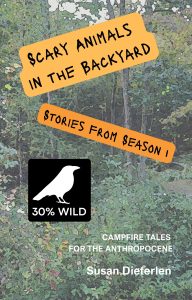
Every coyote, disappearing farmhouse, and Green Man,
Ready for a campfire near you
Plus “No Heroes,” a bonus story only in this e-book
Escape from The Doom
But also: your little backyard habitat makes a better habitat for YOU. A calmer, more relaxed, more peaceful you. Having a place for wildlife just outside your door builds in a mental health break in your own life, a tiny vacation you can take daily. This kind of potent stress relief adds up in your health. It can even make us feel more at home on and connected to the land where we make our home.
You all remember The Doom, right? You know The Doom, whether you realize it or not. It’s the message we get that big scary things are happening and nothing we do will matter, that all you can do is cower under the bed and hope to hide as long as possible. Or maybe just tune out entirely and learn to ignore the dread in the pit of your stomach, because The Doom is loud and tough to shake.
At the start of this season, The Doom was about climate and the overwhelm and fatigue of the daily, sometimes hourly, stories we hear about another catastrophe and another harbinger of apocalypse. It’s easy to feel hopeless about extreme weather. But maybe there’s other Dooms in your life, too. I could list some things, but if you’ve got overwhelming worries that make you feel helpless, you don’t need me to call them to come crowd around you. Those worries are already there.
Here’s the good part: that backyard wildlife habitat? Can be a place for you to step back from The Doom and catch a breath. It does this *at the same time* that it gives the birds and bees or what have you a spot to rest and recover, a kind of multi-species breather. And it’s very easy to get this calm. In fact, it’s no effort at all, because we do it automatically. You sit and observe the wildlife and the nature, and that observation is like a meditation.
A healthier you
But wait, there’s more good news! That moment of respite, staring at the butterflies doing butterfly things? It makes you healthier. A place to escape The Doom makes you more resilient to whatever, and that might even head off some other future Dooms. There’s a long list of health benefits from spending time in nature – like your backyard habitat – and yes, that’s backed by science, plenty of it. Those include mental health benefits, like easing depression and anxiety, and fighting some of our deadliest chronic diseases, like heart disease. Being calm in your habitat is a lot like meditation, and that, too, has some very appealing health benefits, like better sleep and lowering blood pressure. These too are backed by science, which are my very favorite kind of health benefits.
Peace on demand is resilience
These are all impressive ways to say a simple truth: that it’s good for us, even life-changing, to find a way to calm down. This is never more true that when The Doom has its claws in you. Whatever comes, we face it better with this Calm Place on our side. Peace on demand is a potent tool for resilience, resilience to more or less anything.
So take a deep breath, then exhale, and take this with you:
We can’t change everything. Not as individuals. But we can change what’s around us, the bits that touch our own lives that ARE in our control, and we can spread the word to those around us who might want to do the same.
Our changes, this shaping, can link up with the changes of others, like habitat connectivity, and form an archipelago of oases, a constellation of lights showing the way through the darkness, the darkness of The Doom around you. As anthropologist Margaret Mead is said to have said,
“Never doubt that a small group of thoughtful, committed citizens can change the world: indeed, it’s the only thing that ever has.”
There’s rest and renewal awaiting you, and the wild creatures around you. What have you got to lose?
For more facts and figures about all this, see “How to (Re)Build Your World for Wildlife.”
Prefer to listen rather than read?