

Episode 1.8: "Back from the Dead, aka Rewilding"
Find us where you listen to podcasts at thirtywildpod.com
“30% Wild” podcast episode summary
What past life is in your yard, waiting to be resurrected? What do zombies have to do with ecology? In the spookiest way possible, we dig into rewilding your yard, neighborhood, or even whole regions. Get all the basics on bringing nature back to a space near you, including why you’d want to and how you’ll benefit.
Plus pro tips about how to start with a tiny rewilded patch, right in your own backyard, porch, or patio, and remaking the world, one tiny action at a time.
We also join a lonely coyote on a hair-raising night full of urban myths – and invasive species.
Listen to “Back from the Dead, aka Rewilding,” and subscribe to “30% Wild” at www.thirtywildpod.com
- The basics on rewilding, in campfire story/urban myth style
- Accidental rewilding through neglect, and the sometimes-creepy places it creates
- Invasives vs native species
- Nature keeps us healthy
- What good is a tiny rewilded patch?
- Doing what you can with what you’ve got
- Choosing a good rewilding site
- Making a small-site rewilding plan
- Pro tips about plants, tools, and materials
- Includes the original story, “Hitchhikers.”
Please scroll down to the bottom of the page for a full transcript of this podcast episode.
Rewilding, but with Zombies
Read all about it:
A spooky campfire tale where nature returns…different
Online Course: How to Rewild a Backyard Corner
Coming Soon!
Resources and Links
Resources and more to explore about urban wilds and rewilding
Spooky Hollows: Fear and Protecting Nature, on how our avoidance and neglect of places we fear can make them accidental nature preserves
Haunting the Forest: Super(hero)natural, about the rewilded forest of Connecticut and its wealth of human artifacts, past and future
Design by Deficit: Neglect and the Accidental City, Susan’s book on accidental rewilding and other ways that neglect shapes the places we live.
Plus: scroll down for a *free* excerpt from Design by Deficit, “A Guide to Urban Wilds!”
What overgrown and neglected places do for us: Shrubbiness: When a tree isn’t a tree,
Nature keeps us healthy, in both body and mind (soul, too): Wild and Healthy
We need birds to control insects for our own good: Ravens and Raptors
More about that Big Bad Wolf, lurking in the woods or maybe your local coffeehouse: Big Bad (Imaginary) Wolves
Headless Hessian, aka the Headless Horseman, was a real guy, sort of: https://emergingrevolutionarywar.org/2016/10/30/the-headless-horseman-and-the-revolutionary-war/
Places made only for people vs places made to be shared with wildlife: How to (Re)Build Your City for Wildlife
Habitat fragmentation and connectivity, what it is and why it matters
Resources for creating your own tiny rewilded site
A good rewilding site is:
A spot you see every day, whether outside your door or looking out a window. Bonus points for a spot that’s both!
A spot with expendable plants in it right now, something you won’t miss or already want to get rid of.
Close to water, for the first part while you’re getting the new plants established.
Not a place that the neighbors or landlord will object to. Give yourself a chance to try something new without a built-in critical audience.
Either sun or shade will work. Hilly or flat, wet or dry can all work. Doesn’t matter much what the soil is like, either.
Pro tip: Make it easy on yourself by choosing a spot that’s NOT full of tall weeds rooted firmly into the ground, which can be hard to kill. For containers, this doesn’t matter, because you can dump out the weeds and start with new soil..
Recommended tools for your first rewilding project
If you’re planting in the ground, you need:
Plants
Garden rake
Shovel or other tools needed to remove current vegetation
Gloves to protect your hands
Trowel to dig holes for plants
Mulch, such as shredded wood, lawn clippings, or straw
Watering can or hose connected to spigot
If you’re rewilding in a container, you also need:
Soil
Drainage material for bottom of pot, like gravel
Credits for the original story, “Hitchhikers,” included in this podcast episode
“Hitchhikers” is an original work by Susan Dieterlen. It is inspired by a host of other stories, from the ancient to pop culture, involving Coyote, the Green Man, several urban myth ghost stories, and the recent book, “Jackalope,” by Denise Low.
Green Man, aka the Hookman, aka invasive species personified
Coyote, a recurring presence in Native American stories
Hookman, an absolutely classic urban myth
Resurrection Mary , a vanishing hitchhiker tale from the Chicago area, among many ghostly hitchhiker/prom girls/brides alleged to be haunting our roadways
Crybaby Bridge, an archetypal story that pops up in many different locations
Emerald ash borer
Spotted lanternfly
Kudzu
Asiatic bittersweet
Autumn olive
Credits:
Theme music by Lost Harmonies
Raven audio recording by Tyler Hulett
Other sound effects by WeVideo
Other music by Alitu.
The Complete Collection from Season 1
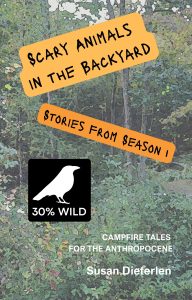
Every coyote, disappearing farmhouse, and Green Man,
Ready for a campfire near you
Plus “No Heroes,” a bonus story only in this e-book
Full transcription of podcast episode
[00:00] Susan: The setting sun is blazing down the highway as a coyote jogs up to the abandoned rest area.
[00:07] His last ride rolls over the cracked asphalt and speeds away, the sun shining in its tail lights.
[00:14] The coyote stretches stiff from the long ride in the passenger seat. But there’s urgent business afoot.
[00:22] Finding a place to pee.
[00:24] Still, he sniffs a bit and wanders into the overgrown brush, hunting for the right spot. A canine to the core,
[00:32] this decrepit scene is full of possibility.
[00:35] A place ripe to be retaken.
[00:37] The goldenrod and aspen have already started.
[00:40] The land is coming back.
[00:42] It’s time to mark it in the right place to be sure it comes back to him.
[00:48] This could be just the spot for his niece and her pups. One of several right spots anyway.
[00:54] Can’t have too many backup density.
[00:56] This is a place no one goes, or no one on two legs at any rate.
[01:01] Thousands of vehicles pass it daily, but not one driver will see it and certainly no one will stop.
[01:07] The pavement is crumbling, weeds sprout everywhere, and the buildings are boarded up, tagged here and there with half hearted fading graffiti.
[01:16] Too abandoned for humans, too human for wildlife. Forgotten by everyone,
[01:21] hidden from view and all sound muffled by the hum of passing cars.
[01:26] In other words,
[01:28] perfect.
[01:29] The coyote wanders around the boarded up building, past an open shed full of rusted vending machines, its roof caved in.
[01:37] The coyote trots on around a clump of trees he doesn’t recognize. In the broken parking lot.
[01:43] He’s sniffing around its edges when a long screech shatters the somnolent hum of traffic.
[01:49] The coyote’s ears flatten and he freezes,
[01:53] one paw still in the air,
[01:55] metal on metal, an unnatural sound, and right behind it, the gunning of an engine and the squeal of tires. A car bursts from behind the trees, accelerating for the highway as though chased by the devil himself.
[02:08] It’s on the highway in seconds and passing every car and truck bound for elsewhere at top speed. The coyote shakes. Humans and their noise, he thinks.
[02:18] But why were they here?
[02:21] Maybe this spot isn’t so abandoned after all.
[02:24] The coyote picks his way along the edge of trees toward where the car was, keeping to the shadows.
[02:30] Here the plants are strange to the coyote. Pushy newcomers, not the old friends he’s known for centuries.
[02:37] He listens, ears swiveling,
[02:39] but there’s no sign of humans except for the trash. Those drifts of roadside refuse. Cars seem to emit like exhaust.
[02:47] Stillness.
[02:49] He exhales and scans the cracked pavement in the dim light of the last rays of sunset. And turns back toward the trees.
[02:57] His nose tells him there’s nothing there either,
[03:01] but the fur prickling on the back of his neck says there’s someone here,
[03:07] someone watching.
[03:09] Maybe he’s just imagining things after the long ride,
[03:14] time to get his thumb back out and find someone else. Headed eastbound,
[03:20] he turns back the way he came, checking every direction so he sees the figure appear at the edge of the woods.
[03:29] One moment there’s just a thicket of autumn olive and buckthorn,
[03:33] and then a man stands there,
[03:36] his rumpled raincoat and battered hat nearly indistinguishable from the branches around him,
[03:42] all of it a dusty gray green.
[03:45] The coyote instinctively bares his teeth, but that snarl is gone in a flash, replaced by a smile that doesn’t reach his eyes.
[03:55] Evening, stranger. What brings you out on this fine night? He says.
[03:59] His glances count the escape routes so quickly no human eyes could follow them.
[04:05] Assuming this stranger is human.
[04:09] The man in green steps just one pace out from the wall of vegetation tendrils curling near his feet.
[04:16] Hello, he says,
[04:18] like he’s trying out the words for the first time.
[04:22] His voice is a husky rustle, like fallen leaves blowing across pavement.
[04:27] The coyote can’t place his accent, just that it’s nothing familiar.
[04:32] The hat shields his face.
[04:34] The stranger keeps his hands in his pockets, but a dust falls from his coat’s hem, a rain of seeds seeking the pavement. Cracks,
[04:44] sprouts appear in an instant, but nothing the coyote recognizes.
[04:49] The green man says nothing else.
[04:51] He gives nothing away.
[04:53] Even in the silence, the coyote seems to hear that peculiar rustling voice.
[05:00] Then the coyote realizes that’s the thicket whispering in the breeze.
[05:06] Resisting the urge to step back, the coyote tries again, his voice too loud and trying too hard.
[05:13] Were those your friends in that car? They sure were in a hurry to get gone.
[05:17] Inwardly, the coyote rolls his eyes. He always gets too folksy when he’s nervous.
[05:25] Friends?
[05:26] The green man rustles.
[05:28] Yes,
[05:29] they were friends again. The words sound disjointed, unfamiliar.
[05:38] More seeds fall, more sprouts.
[05:41] Maybe this isn’t the green man’s native language.
[05:44] The coyote could switch into Spanish or Chippewa or Potawatomi or an even older tongue,
[05:51] but he’s betting this stranger won’t understand those either.
[05:56] It’s not the language,
[05:57] it’s speaking words.
[05:59] Maybe it’s using a mouth to form words instead of something else.
[06:06] Well, I hope they’ll be back soon, too.
[06:09] The coyote breaks off as something brushes his foot.
[06:13] He looks down to see a bittersweet vine twining up through a crack in the pavement,
[06:17] visibly growing at an incredible rate,
[06:20] wrapping around his ankle. He shakes it off and steps aside, looks up, preparing to laugh it off, and finds the stranger is closer to him,
[06:29] much closer.
[06:32] The coyote stumbles backward, the fur on his back standing up. Hey, did you see what exit number that was to the West? Was it 280? I think it was 280.
[06:40] The coyote talks fast and thinks faster.
[06:44] The stranger is close enough now for the coyote to see a glimmer of eyes under the hat brim, a pale green flicker,
[06:51] and around his face, jagged points and serrations gently undulating with the breeze, echoing the movement of the leaves behind him.
[06:59] There’s not hair exactly, just vegetation.
[07:04] A tendril wraps around the green man’s hat band and a small movement there catches the coyote’s eye.
[07:10] A spotted insect spreads its wings with a flash of bright red and lifts off to be joined by several more spotted lanternflies from the back of the hat, heading toward the trees.
[07:23] The coyote quickly looks back at the glimmering eyes. Have they gotten closer again?
[07:29] His sensitive nose is overwhelmed by a heavy perfume, floral, sweet, yet soapy, catching at the back of his throat.
[07:37] The coyote sneezes and, looking up, finds the green man now just an arm’s length away.
[07:43] He’s pulled a hand out of his coat pocket and it’s covered in scales iridescent and shiny green.
[07:50] But wait, those two are insects,
[07:53] as hundreds of emerald ash borers take flight into the night beneath them. The stranger’s hand is weathered and gray,
[08:01] like wood left outside for centuries.
[08:05] A beetle lands on the coyote’s shoulder and he brushes it off, his eyes locked on the green man’s. But his paw feels not the tiny body of an insect, but a sturdy sprout of kudzu grasping from the thicket behind him.
[08:19] He twitches and jumps, finding the kudzu has grown up his back, tendrils reaching his ears and creeping around his neck.
[08:26] The vines, now wrapped around his tail, are pulling him toward the thicket.
[08:31] The coyote shakes his head, vigorously dislodging kudzu and the drowsy scent of autumn olives. He jumps away from the thicket, away from the vines, and most especially away from the stranger.
[08:41] But now the stranger is smiling, and that smile is the worst thing the coyote has seen in his long, eventful life.
[08:50] The stranger’s wooden hand reaches for the coyote as though to help, but no, the hand waves and the kudzu follows it, springing up out of the cracks around the coyote’s paws and tying his legs.
[09:04] With a yip, the coyote rise in the grasp of the vines, but his paws scramble on the pavement, only slowing his progress into the sinister thicket.
[09:13] Desperate now, he falls to all fours and scrambles with all four feet. His front claws find purchase in a crack in the asphalt, and with a mighty tug the coyote is free from the vines.
[09:25] He sprints toward the darkened building. A leap, then another. He’s at the corner, the vine slithering behind him. The stranger’s eyes blaze green now, his grin ferocious. Ferocious and hungry.
[09:36] He throws both hands in the air, commanding the vines to rocket even faster toward the coyote. The dim light shines on his hands, the weathered wood of one,
[09:46] and at the other a stump with a shining hook at its end.
[09:52] Something dangles from the end of the hook.
[09:55] Maybe it’s paint from a car door, or maybe it’s something more organic and much more grim.
[10:09] The coyote stumbles onto a quiet country road, having raced cross country from the highway through fields and prairie, shying away from any kind of shrub or woods.
[10:21] It’s full dark, but his eyes were made for this.
[10:24] He pauses, panting,
[10:27] and looks at the empty road to his left,
[10:30] then turns and looks at the empty road to his right.
[10:34] All deserted.
[10:36] This is as good a spot as any.
[10:39] He sticks out his thumb, turns back to face oncoming traffic from the west, and something crunches under his paw.
[10:46] It’s a handful of twigs tied into a two legged figure around an inverted triangle.
[10:55] Confused,
[10:55] the coyote looks up and sees her.
[10:59] The woman in white standing at the roadside.
[11:03] No,
[11:04] a girl,
[11:05] really.
[11:06] In a fancy gown.
[11:08] Maybe a prom dress?
[11:10] Or is she a bride?
[11:13] As the coyote looks, she turns slowly and faces him,
[11:18] her bottomless gaze dark as the grave.
[11:22] The coyote’s ears prick up as distant wailing like a baby’s cry reaches him.
[11:30] Nope,
[11:31] says the coyote, turning in one fluid motion. He lopes away on all fours through the dark night,
[11:39] eastward toward morning.
[11:45] I’m Dr. Susan Dieterlin and this is 30% wild scary animals in the world backyard. Listen, subscribe and support 30% wild@30wildpod.com that’s t h I r t y wildpod.com the ghost of your yard is a forest or a prairie, or even a wetland.
[12:12] Maybe it’s your neighborhood or your whole town. But in any case, what’s haunting your house is this past what grew on the ground under your feet long before you moved in.
[12:25] Like any good ghost story, this one’s about what happened long ago on this very spot,
[12:34] and how it’s not quite gone.
[12:38] Today,
[12:39] the Past of your yard is so close,
[12:42] lurking just out of sight,
[12:46] that all it takes to rise from the dead is for you to get distracted.
[12:50] Like, for example,
[12:52] by a spooky story or a scary movie.
[12:58] The past of your land, the land where you live,
[13:02] will rise up,
[13:04] a wispy vapor of ectoplasm, thirsting for vengeance and retribution.
[13:11] Not really.
[13:12] But ignore land long enough and it becomes like that abandoned rest area along the highway.
[13:18] A place where nature has taken over, where nature has taken the land back.
[13:25] Nature rising like the undead and reclaiming land is what we call in calmer, less late night at the drive in tones, rewilding.
[13:36] Sometimes we make this happen deliberately.
[13:39] Looking in a mirror in a candlelit room and saying rewilding three times.
[13:47] Disclaimer.
[13:48] Actual rewilding process may vary.
[13:51] Obviously.
[13:53] Sometimes rewilding happens in places. We abandon the boarded up house on the edge of town with those mysterious lights flickering behind the broken windows.
[14:04] Only the landscape version.
[14:07] Places like the yard of that house or the farmland around that house, or the old mine site down the road from that house where no one ever goes.
[14:16] Probably because of that accident, that horrific accident 50 years ago tonight.
[14:23] Not really, but also kind of. Sometimes some places really do rewild because we are afraid of those places because of history or contamination or very real present threats.
[14:38] Chernobyl and the Korean DMZ are the classic examples of this. But there’s more on the website about that with examples closer to home.
[14:48] Eerily close to home.
[14:51] Seriously though,
[14:53] when we stop doing all the work we do to keep land pretty and tidy and keep the buildings and roads we build on it in good repair because we are afraid of that place, or more likely because we just don’t want to pay for it or we don’t really care about it.
[15:10] Things fall apart.
[15:12] What they fall apart into often is a kind of rewilding.
[15:18] I am really into this kind of rewilding. The behind your back, out of sight nature that creeps up behind your back.
[15:26] Like that hookman sneaking up behind you right now.
[15:31] I am so into that accidental rewilding that I wrote a book about it.
[15:38] That book is called Design by Deficit Neglect in the Accidental City.
[15:42] Design by Deficit doesn’t really turn the clock back though. It doesn’t give you the pre settlement past. Like that forest was on your doorstep in 1491.
[15:55] Like in every campfire story ever told about summoning spirits from the beyond. The long gone forest doesn’t come back just like it was.
[16:07] It comes back different.
[16:12] You get not a ghostly prom queen with eyes as deep as the grave,
[16:19] but rather a resurrected nature that’s a mix of survivors, invasives and natives.
[16:26] When you take your hands off the wheel,
[16:28] you stop being able to choose.
[16:32] So you may get all tree of heaven, spotted lanternflies, kudzu and feral pigs versus a return to pre settlement Eden life after people. It doesn’t really get you 1491 before people is much much much much much farther back anyway in North America because it’s before Native Americans arrived.
[16:56] Nature does take back over,
[16:59] but it’s like the hitchhikers conflict. It’s like the coyote and the green man fighting for control.
[17:06] That’s a mixed bag of good and bad, depending on your point of view.
[17:09] There is a lot more about that idea and more about Design by Deficit, the book on our website 30wildpod.com Rewilding is usually talked about at more of a major zombie plague scale, like New England plus the Northeast US plus the Appalachians or southeastern Europe.
[17:32] The whole thing,
[17:34] rather than the scale of a lone spooky patch on a dark deserted highway or behind a long abandoned house.
[17:47] But the idea is the same whether it’s a whole region or a single flower bed right by your front door.
[17:54] Resurrected nature is good for us. Us humans too,
[17:58] even if it’s sometimes a little spooky or if it is attractive to coyotes or other hitchhikers.
[18:04] The big message from the beyond on this Ouija board is we humans need nature to survive,
[18:13] if only for our own survival.
[18:16] There is also a lot more about this on our website, but the highlights of it are that nature keeps us healthy.
[18:24] Even if we live in the city or deepest suburbia or endless farm fields.
[18:28] It keeps us healthy by giving us cleaner air and water. And we suffer when air and water are not clean.
[18:35] It keeps the climate cooler and that fights extreme weather.
[18:40] And extreme weather will kill you in a hot minute.
[18:43] It counteracts the impacts of stress on our bodies. Who doesn’t need that?
[18:49] This fights all kinds of chronic diseases and ailments that are caused by or made worse by stress. We hear this all the time. I mean all the time.
[18:57] That whatever ails you, right? Whatever kind of health issue you have is made worse by stress or that stress causes this or that.
[19:08] All of those things having healthy nature around somewhere near you that you can be exposed to. All of those things are helped by having that nature around and being exposed to it.
[19:22] This includes things like cardiovascular disorders and high blood pressure. So these are real killers. These are things that kill a lot of Americans. Those are some top 10 killers having nature around where it’s someplace where we can see it also speeds our healing so when something goes wrong,
[19:41] you will come back faster and better from it.
[19:45] Nature around us also gives us a mental health boost in addition to all this physiological health stuff.
[19:53] That mental health boost may be exactly the antidote we need in the 21st century, because so far it’s a pretty terrifying ride. In this century,
[20:03] that mental health boost could be just what you need to stop that crazy ax wielding maniac that’s headed for your back door.
[20:15] Or at least to make all of our lives a bit less plagued with depression and anxiety, which are some modern day plagues that can make you feel like a zombie.
[20:26] Having more natural land around also helps keep pollinators around, and we need those pollinators for food production.
[20:36] That is a real life scary situation.
[20:39] We also want to keep birds around because they control insects and that can stop some non zombie real life plagues. And keeping healthy nature around really helps those birds. That’s something you can learn more about in our Ravens and Raptors episode in this season of 30% wild.
[21:01] So we can get all of that, all of those benefits just by letting land get a little more wild.
[21:09] Even better,
[21:10] we can get all those by letting a lot of land get a lot wild,
[21:15] or a lot of little pieces of land all over get kind of re wild.
[21:21] Tiny wildnesses all over a million spots for coyotes to sniff around,
[21:30] an endless supply of thickets for the green hookman to ooze out of,
[21:37] vines twining around his shining single hook.
[21:42] A lot more woods to get lost in shooting that shaky found footage,
[21:49] you might run into a bloodthirsty cackling witch, or a headless hessian,
[21:54] or even the big bad wolf.
[21:58] But what you won’t find is a future without birds or pollinators or winters.
[22:06] Rewilding is a potent tool to keep those scary stories around the campfire and not in the actual news headlines.
[22:24] It’s so easy to be carried away by how much various authorities control like the big guys make all the decisions and are the only ones that matter while the rest of us scramble to survive in the world they make.
[22:39] But most of your life is only in your control.
[22:44] Really think about it.
[22:47] Unless you’re one of the tiny number of people who live the billionaire lifestyle of paying or promising to pay lots of people to do absolutely everything around you.
[22:57] You’ll have to listen to someone else’s podcast for that though, because I know nothing about that lifestyle and I am betting that you don’t either.
[23:06] Let’s look at the places you live in.
[23:09] The hands that actually do the work that makes and maintains the places you live in day to day.
[23:16] Those hands are usually yours and no one else’s.
[23:20] Special note.
[23:21] This is still true. Even if you’re the sort of person who postpones, delays, or avoids that work by choice or by necessity.
[23:29] That stuff you don’t get done still shapes the places where you live. I can’t help mentioning that because I wrote a book about that designed by deficit. You know, there’s a lot more about that in the episode notes on our website.
[23:44] But back to our hands shaping where we live.
[23:47] You don’t believe me?
[23:48] Let’s change something.
[23:51] Start small,
[23:52] because remember, you’re making this change all on your own.
[23:57] Or really you’re doing it with my help. We’re doing it.
[24:01] We’re changing your world.
[24:04] Somewhere in your life, there’s a patch of soil that’s ripe to be rewilded. And you’re the only one who can do that.
[24:13] Maybe it’s a flower bed.
[24:15] Maybe it’s a dull patch of lawn that you are sick of looking at.
[24:18] Maybe it’s a flower pot on a balcony or even a window box planter you control that.
[24:25] Want to have a bit more wild in your life? A place where you make wildlife scary or no, at home, in your own backyard.
[24:32] That’s your spot.
[24:34] Or at least it’s the first spot.
[24:38] That’s what we do, we people who don’t have the world telling us we’re the only ones who matter.
[24:45] We do what we can with what we have,
[24:49] where we can.
[24:50] Then we get up the next day and we do more.
[24:54] And again and again and again.
[24:58] When lots of us do this again and again and again,
[25:04] it remakes the world.
[25:07] What good could that do remaking just a tiny piece of the world? The tiny piece you can control.
[25:13] In this case, rewilding, like neglect,
[25:16] piles up.
[25:19] Said in more sophisticated terms. Every rewilded patch, no matter how small, adds another island in the archipelago of habitat running through your town or neighborhood.
[25:30] Imagine your favorite wild creature,
[25:34] whether butterfly, bunny, or Bigfoot.
[25:37] See them hopping from patch to patch across the city, like crossing a stream on stones.
[25:43] It’s kind of like that.
[25:46] Or like stealing from safe house to safe house in hostile territory.
[25:52] Habitat patches in the city, or any place made only for people,
[25:57] give wild things a chance to rest and refuel before moving on a home base to return to a few other nearby places for plants and butterflies and bees. A small patch could even be a place to live long term.
[26:12] A refuge from the storm habitat. Connectivity like this is critically important to the survival of wild creatures and plants.
[26:21] Connected habitat is the escape route.
[26:24] The plan B When things fall apart.
[26:27] Things like weather that’s become too extreme or another wild place being bulldozed and paved.
[26:34] But how do you do it this Remaking a piece of your own personal world into the rewilded world that you want to see.
[26:42] The first thing you do is counterintuitive.
[26:46] You start small.
[26:49] You want a spot you can manage. Because remember, this is hands on work and those hands are your own.
[26:56] Let’s get them dirty.
[26:58] A small site is enough for now, as long as it’s the right site.
[27:03] What’s the right site?
[27:05] A good rewilding site is a spot that you see every day, whether outside your door or looking out a window. Bonus points for a spot that’s both.
[27:17] A spot with expendable plants in it right now. Something you won’t miss, or something you already want to get rid of.
[27:24] A spot that’s close to water. This is important for the first part. While you’re getting the new plants established,
[27:31] not a place that the neighbors or your landlord will object to. You need to give yourself a chance to try something new without a ready made critical audience.
[27:42] Either sun or shade will work. Hilly or flat, wet or dry can all work. It doesn’t really matter that much what the soil is like either.
[27:52] A pro tip.
[27:53] Make it easy on yourself by choosing a spot that is not full of tall weeds rooted firmly into the ground because those can be hard to kill for containers. This doesn’t matter because you can dump out the weeds and start with new soil.
[28:08] A small site is enough for now if it does what you want.
[28:13] That’s about matching what you do, your actions and selected materials to what you want. Your goals for the pocket sized rewilding project.
[28:22] With rewilding, this mostly comes down to the plants.
[28:26] So think about what you want those plants your plants to do.
[28:31] Maybe that’s welcome bees or butterflies or birds.
[28:35] Maybe that’s be pretty with flowers.
[28:38] Maybe that’s to showcase the passing of the season so that every day is something new outside your door.
[28:45] You definitely want your plants to be suited to the conditions of your site. Things like whether it’s wet or dry, shady or sunny, whether it’s rocky or not.
[28:55] You need the plants that match those goals.
[28:59] That perfect plant list is only so useful if you can’t get those plants. This is really important.
[29:06] You might assume that you can only get cool stuff like this far away that this is an online shopping situation and that is a good way to do it. But never overlook the local.
[29:17] In this case, that’s local nurseries specializing in native plants.
[29:21] Local garden clubs have really embraced native plants and gardens that create pollinator or butterfly habitats, so check with your local club too.
[29:30] They often have plant sales, usually in the spring.
[29:33] They’re also an excellent place to find out about local places to buy plants.
[29:38] Other local gardening groups, including on social media, are great places to ask for recommendations. Even farmers markets can be good places to ask around. You need to get out and talk.
[29:48] Talk to people.
[29:49] You might be surprised about what’s already in your backyard.
[29:55] Your county, city or state may have a conservation office that offers native plants for sale at extremely reasonable prices.
[30:03] These offices are often focused on reforestation after wildfires or other natural disasters or soil conservation, so don’t just assume your state doesn’t have one. Take a look, do a little digging.
[30:16] A couple other pro tips for planting up your space and remember, I started my career as a landscape architect, so these are literally pro tips.
[30:26] If your soon to be rewilded site is a flower pot or other small container,
[30:31] plants in 4 inch pots are a good choice.
[30:35] If you’ve got a site in the ground like a flower bed about to be reborn or restored,
[30:40] plugs which are very small plant seedlings are the way you want to go. Any place that’s focused on native plants will be very familiar with all this. You don’t have to know about it because they will.
[30:52] Seed mixes can be easier to find and are often themed for certain situations that you might like, like wet soil or season long color or attracting birds.
[31:01] Seed takes more work to start successfully,
[31:04] but it is cheaper however you pay in labor and time or you pay in money. You can’t just throw the seed around and expect miracles.
[31:14] Give your plants enough space to grow.
[31:17] Think of them at mature size, not the itty bitty things they are right now, and space them so they will just touch when they grow up. That’s two or three years for perennials like prairie grasses or coneflowers.
[31:29] It’s even more crucial for bigger plants like trees and shrubs because they will get so much larger.
[31:37] You need the right tools to make things happen the way you want for pretty much anything in life.
[31:44] Your official starter list for your first rewilding project is right here.
[31:50] If you’re planting in the ground, you need these things. You need your plants,
[31:55] a garden rake,
[31:57] a shovel or other tools as needed to remove the current vegetation on your site.
[32:03] You are going to want gloves to protect your hands. Listen to me on this A trowel to dig holes for plants,
[32:11] mulch, which could be shredded wood or long clippings or straw or something like that,
[32:16] and a watering can or a hose connected to a spigot.
[32:20] If you are rewilding in a container, not in the ground,
[32:24] you also need your soil and drainage material for the bottom of the pot. Something like gravel.
[32:31] If you missed that, that whole list is in the episode notes on our website. So no worries. If you couldn’t find a pen,
[32:38] take yourself to 30wildpod.com and get that list.
[32:42] That’s also where you’ll find all the lists and resources mentioned in this episode.
[32:48] The final biggest pro tip about changing your world is right here,
[32:54] so take this away with you.
[32:58] It takes vision to see how these humble beginnings will grow.
[33:04] It takes faith to act as though it’s a sure thing, especially when you’re actually full of doubt.
[33:13] So have faith,
[33:16] believe,
[33:19] and then tell a friend and get to work.
[33:24] The world outside your door is waiting to be remade.
[33:31] For a lot more about how everything besides plants like lighting, shelter and you yourself can make or break backyard wildlife habitat, check out the how to rebuild you’d world for wildlife episode of 30% wild in season one, scary animals in the backyard,
[33:49] available at our website on 30wildpod.com.
[34:01] The story hitchhikers is an original work by me, Susan Dieterlin.
[34:06] It is inspired by a host of other stories from the ancient to pop culture involving coyote, the Green man, several urban myth ghost stories, and the recent book Jackalope by Denise Lowe.
[34:21] Learn more about all of these stories and the invasive species hitchhiking with the Green man in the episode notes on our website.
[34:29] There’s also a special section about creepy yet important neglected places and urban wilds like this rest area.
[34:37] All available to you@30wildpod.com 30% wild scary animals in the backyard is created by me, Dr. Susan Dieterlin, and is a product of Deft Space Labs.
[34:55] All parts of this podcast are copyright protected and may not be duplicated or used without express written permission by the creator.