
BOOKSHELF

Meet the Author
Susan Dieterlen, PhD, is a researcher and designer focused on sustainability, clean energy, and how people interact with environments. She is originally from Indiana and currently lives in Connecticut. Dr. Dieterlen holds degrees from the University of Michigan and Purdue University, and has been a registered landscape architect since 2001.

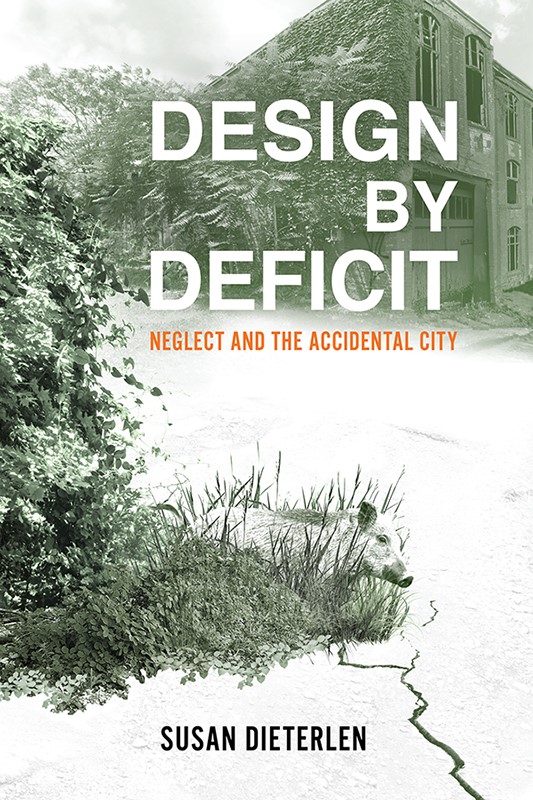
Design by Deficit:
Neglect and the Accidental City
Design by Deficit tackles the array of urgent issues besetting the American city, from crime to infrastructure failure to entrenched inequality, with warmth and wit, taking those new to urban issues by the hand and showing them around the accidental cities crafted by unintended consequences. A surprisingly positive volume, presenting the promise of nature in the city and more resilient sustainable living with scholarly rigor and irresistible flair.
Praise for Design by Deficit
Personable and witty… Delightful to read… Thought-provoking… A book that will stick with me… A lot of food for thought…
Challenges us to open our eyes, look around, and see neglect around us… Wonderful book… Makes me stop and think… Highly recommended
Delightful book… Essential reading… Full of insights… Sharp analysis… Memorable aphorisms… Vivid images… Important ideas… Strong and inspiring new reasons for hope… Passionate… A must-read… Shines a much-needed light on the forces of neglect…
This page may include affiliate links. Buying through them helps support DeftSpace Lab and “30% Wild” at *no* additional cost to you. Thank you!
The Complete Collection from Season 1

Every coyote, disappearing farmhouse, and Green Man,
Ready for a campfire near you
Plus “No Heroes,” a bonus story only in this e-book

Immigrant Pastoral
Midwestern Landscapes and Mexican-American Neighborhoods
Full-length research monograph
Immigrant Pastoral examines the growth of new Mexican heritage communities in the Midwest through the physical form of their cities and neighborhoods.
The landscapes of these New Communities contrast with nearby small cities that are home to longstanding Mexican-American communities, where different landscapes reveal a history of inequality of opportunity. Together these two landscape types illustrate how inequality can persist or abate through comprehensive descriptions of the three main types of Midwestern Mexican-American landscapes: Established Communities, New Communities, and Mixed Communities. Each is described in spatial and non-spatial terms, with a focus on one example city.
Specific directives about design and planning work in each landscape type follow these descriptions, presented in case studies of hypothetical landscape architectural projects. Subsequent chapters discuss less common Midwestern Mexican-American landscape types and their opportunities for design and planning, and implications for other immigrant communities in other places.
This story of places shaped by immigrants new and old, and the reactions of other residents to their arrival is critical to the future of all cities, towns, and neighborhoods striving to weather the economic transformations and demographic shifts of the twentieth and twenty- first centuries. The challenges facing these cities demand the recognition and appreciation of their multicultural assets, in order to craft a bright and inclusive future.

Neighborhood Microgrids
Replicability and Revitalization
Postindustrial cities share with other areas the challenge of the transformation to a post-carbon age. This includes the incorporation of clean energy and the dismantling/vacating of fossil-fuel infrastructure, profound impacts on the physical landscape and public acceptance at many scales. During 2015-2016, Dr. Dieterlen led a study of opportunities for replicability of neighborhood microgrids (power systems) across New York state, and the potential for such microgrids to support economic revitalization efforts.
“Neighborhood Microgrids: Replicability and Revitalization” was sponsored by Syracuse Center of Excellence as a separate but related investigation to the NY Prize award assessing the feasibility of a community microgrid for Syracuse’s Near Westside. The report below presents the findings of this study, including a process for identifying likely neighborhoods for replication of a model neighborhood’s microgrid for revitalization, and results of this process as applied to the Near Westside. A brief executive summary precedes the full report; please click on the button to view both summary and report.
