

Episode 1.9: Fear in the Woods"
Find us where you listen to podcasts at thirtywildpod.com
“30% Wild” podcast episode summary
What makes a place creepy, and most especially, what makes the woods spooky? Is it just the animals that are scary, or is there something else waiting off the trail? From abandoned cabins to strange echoes, we run away with our imaginations and delve into the research on what we like and don’t like about potentially threatening places in the outdoors. Plus how to have the best haunted house or front yard this Halloween.
We also get just freaked out enough on the trail of a long-ago crime, deep in the Connecticut woods.
With stories from this season’s wildlife experts about what to worry about when you’re alone in the woods, and what they’ve seen and heard out there.
- The deep dark woods as iconic creepy place
- Halloween decorations and cliched spooky places – why are *these* the places we fear?
- Mysterious crashes in the woods at night
- Mistaking bears for Bigfoot
- Anecdotes ain’t science
- Working in the woods alone after watching scary movies
- Trusting your gut vs dismissing your anxieties
- How to handle your fears in the woods
- Taking care of scary places by avoiding them
- Snakes and cheeseburgers
- How to stay safe from scary animals in the woods
- How to keep your dog safe in the woods
- Includes the original *true* story, “Coincidence?”
This Episode’s Guests
This episode features clips from several guests interviewed during Season 1 of “30% Wild.” Thanks to all of them!
Trevor Edmonson from The Nature Conservancy in northern Indiana
Dani Freund from the Voyageurs Wolf Project
Dr. Tracy Rittenhouse from the Department of Natural Resources & the Environment at the University of Connecticut.
Brian Roell from the Michigan Department of Natural Resources
Learn more about them and check out their full interviews in each of these episodes of “30% Wild:
Eat Burgers, Save the World: Bison
Big Bad Imaginary Wolves
Bear-anoia
Mountain Lions in the East
Please scroll down to the bottom of the page for a full transcript of this podcast episode.
For Love of the Dark Scary Woods
Read all about it:
What makes a place creepy?
Resources and Links
Resources mentioned in the episode
Spooky Hollows, about how our fear of “haunted” or otherwise scary places can turn them into accidental nature preserves
Haunting the Forest, about the abandoned roads, foundations, and stone walls that litter the rewilded Connecticut woods
That ax murder on the bad-vibes semi-abandoned road: https://sperrypark.org/wp-content/uploads/2024/10/ax_murder_story.pdf
The Anthropocene, what is it and are we living in it?
Scientific research on physical characteristics of places that make people comfortable or uncomfortable with them. Like all big studies, these are about people in general, on average, so your individual mileage may vary!
With People in Mind: Design and Management of Everyday Nature, a book (remember those?) by Rachel Kaplan, Stephen Kaplan, and Robert L. Ryan. Also known as the “textbook” (it’s not a textbook) for Susan’s old “People in the Environment” college course.
Markers of human care of landscapes, called “cues to care” in the research
Green Cities: Good Health, an absolute treasure trove of all kinds of findings from rigorous scientific research about how we interact with spaces
Your chance of death in the USA by:
Plus: Vision Zero, which is working to get deaths on American roads down to zero, especially for pedestrians and bicyclists
How car emissions and air pollution generally hurts our health
EXTRA: Consider this: all kinds of allegedly paranormal sites are about the *sites* themselves, not the paranormal at all, that the shape, sounds, geology, and other objective physical characteristics of those spaces offer “perfectly logical explanations” of our experiences there. Maybe?
Like, for example, the Moodus noises in Connecticut
The Complete Collection from Season 1
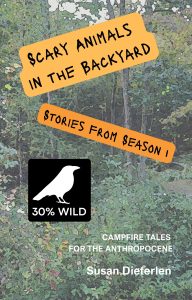
Every coyote, disappearing farmhouse, and Green Man,
Ready for a campfire near you
Plus “No Heroes,” a bonus story only in this e-book
Credits for the original story, “Coincidence?” included in this podcast episode
The story, “Coincidence?” is an original work by Susan Dieterlen.
It is inspired by her real-life lived experiences in Woodbridge, Connecticut.
Credits:
Theme music by Lost Harmonies
Raven audio recording by Tyler Hulett
Other music by Alitu.
Full transcription of podcast episode
[00:01] Susan: This is a true story.
[00:03] It is my true story.
[00:07] Not long ago,
[00:08] I lived near a dirt road through the woods that was closed to cars, at least in the winter.
[00:14] That sentence alone may be creepy enough for you wherever you live, but this road is in Connecticut, where there are many old roads winding through the woods. Some are regular roads with houses and cars and everyday traffic, but others have become mere traces through the trees,
[00:31] the memories of roads connecting foundations of bygone houses and farms that have left only stone walls.
[00:40] These abandoned roads fascinate me.
[00:43] So much of what we do doesn’t last.
[00:46] Despite our best efforts,
[00:49] things fall apart.
[00:52] This particular road, near which I used to live, is neither everyday nor abandoned. Being open to cars some parts of the year and closed others. It’s a fine place to walk in the winter without those cars.
[01:05] You leave your car at the gate and follow the road as it winds up and down, going deeper into the woods.
[01:12] You’re well out of earshot of houses and cars by the time the road starts to plunge through a series of blind curves.
[01:21] Down it goes and down again to a rocky creek that cuts through rock faces in a cascade,
[01:27] once a ford, now a tenuous bridge, at least until the next storm hits.
[01:32] Beyond the creek, the road repeats these curves, up and around and up again, before it eventually turns and heads back to civilization.
[01:41] That bit where it winds down to the creek,
[01:45] that is where your neck starts to prickle.
[01:50] I am comfortable out in the woods on my own, so this is strange.
[01:55] This is something different.
[02:00] There is something about that plunge to the creek and back on this lovely, peaceful walk through the woods.
[02:08] It’s not just me either.
[02:10] A local cyclist volunteered about this road to me, that it’s a good ride, but it’s not one that he wants to do too close to dusk, and most especially not where it descends toward the creek and back up.
[02:24] There is a vibe there,
[02:26] the kind of vibe that makes you look over your shoulder and quicken your step.
[02:31] The kind that makes you notice whether your footsteps are the only ones you hear or do you have some kind of company?
[02:42] A critical scientific eye might ask, what is up with this road? And since I have two of those eyes, I asked myself what it is about that place that makes it spooky.
[02:53] As I walked there through the winter woods, listening for those phantom footfalls.
[02:59] It’s just where the banks begin to rise, or rather, where the road winds downward and the land to either side remains high. The things go south vibe wise.
[03:09] Old roads wear into the earth. Over the centuries, all those horses hooves and wagon wheels, all those muddy ruts. And long before there was a bridge there, those horses had to be able to descend to the creek to ford it.
[03:21] So you descend and the banks on either side rise. They close the sight and sound.
[03:26] Some of the banks are solid rock and the sound of the creek bounces off this rock. We love a babbling brook, the lullaby of water. But here, that white noise is all you can hear.
[03:37] There’s no wind,
[03:39] there’s no sound from any bear or coyote or other scary animal stalking through the woods above.
[03:45] As the road turns back on itself, those high banks muffle all sound both ahead and behind you.
[03:53] You’re in a box of sorts with a steeply slanting floor.
[03:57] Just you and the creek and the absence of any kind of awareness of what may be behind you or awaiting you in front or coming from either side.
[04:07] There is, in short,
[04:08] no view.
[04:10] Science tells us we don’t like places like this where we can’t see beyond where we are and understand what’s out there. It’s too hard to know what to expect.
[04:20] It’s too hard to tell what we see there.
[04:24] An abandoned road in the deep woods is one thing, but as long as you can see into the trees is fine. It’s peaceful, it’s woodsy, it’s a great day outdoors.
[04:33] But add those walls of rock and earth and muffle sound with that water falling and it becomes another story.
[04:41] It becomes a story about what evolution has taught us about how to survive on this planet and how our minds are wired to help us do just that.
[04:51] Stay where you can see the direwolves and short faced bears that may lurk along the path.
[04:58] So there it is.
[04:59] It’s a perfectly logical explanation that you knew was out there. It’s all about that trapped feeling. Space,
[05:05] sight lines, muffled sounds, no hocus pocus,
[05:09] nothing going bump in the night.
[05:14] Except later on I got to talking with a local historian about this part of town and old roads in the woods there. And casually she just tosses out, you know about the axe murder there, right?
[05:28] I did not know about the axe murder and you don’t either. So here it is.
[05:35] About a century and a half ago,
[05:37] a real live lunatic killed a real live man in these woods as he drove a sleigh along this road.
[05:44] Was one of two people he’d kill on that New Year’s Day with an axe,
[05:50] an actual axe murderer.
[05:53] Right there along the banks of that creek, down all those blind curves where your neck prickles,
[06:00] right about where the road hits peak, spookiness Something very bad happened a long time ago to someone traveling this road who perhaps would have wanted to see who else was traveling the road with him and hear what was coming.
[06:22] Maybe it’s a coincidence.
[06:26] Maybe it’s something else.
[06:31] I’m Dr. Susan Dieterlin and this is 30% wild scary animals in the backyard.
[06:37] Listen. Subscribe and support 30% wild@30wildpod.com that’s T H I R T Y wildpod.com.
[06:49] Rittenhouse: I was doing night work and I was. It was an all nighter,
[06:53] so I had to collect these samples every hour, all night long in the rain.
[06:59] And so I would set the alarm on my watch to go off every hour so that I wouldn’t fall asleep because I would like collect my sample and I’d have to stand there in the rain for an hour.
[07:09] Right. It’s really long time. So I’d lean up against the tree and you’d start to fall asleep.
[07:14] And one night when I was doing that,
[07:18] I was not woken by my alarm on my watch, but I was awoken by this crash, this huge loud crash.
[07:26] And it turned out that the sound was because I was standing near a drift fence.
[07:32] So a drift fence is a fence that you build around a pond or wetland to catch frogs and salamanders. And we build it out of aluminum flashing like they use at construction sites.
[07:42] And a frog had jumped up against the fence and made this loud crashing.
[07:51] But I tell you, when I heard that noise, I was terrified.
[07:56] Absolutely terrified.
[07:58] Susan: I bet.
[07:58] Rittenhouse: Yeah.
[08:00] You know, it took me 3, 4, 5 minutes to figure out, like, what? I quickly figured out that the noise had come from the fence,
[08:08] but still, like, something had to have hit the fence to make that noise, right? Like, yeah.
[08:15] So all of my scary experiences have really been things like that.
[08:23] Susan: What makes a place creepy?
[08:26] Spooky season is getting underway as I record this Halloween. Decorations are going up. Haunted houses are opening up in a great wave of pumpkin. Spice is rolling across the land.
[08:39] The long anthropocene summer is hanging on. But the mists of autumn are here in the morning and the goldenrod and asters are in full bloom.
[08:49] Spooky season goes all in on creepy environments. And the more cliched, the better.
[08:55] The abandoned house, a graveyard, a mad scientist lab. Gotta have a rundown circus because you know there’s going to be clowns.
[09:05] Those cobwebs, bare branches, and the fake tombstones you put up at home draping whatever you’ve got in black. They all have this kind of vibe to them.
[09:15] And your task in that is to make an ordinary place like your house. It doesn’t get more ordinary than that or a commercial building spooky.
[09:25] You’re chasing a creepy vibe.
[09:28] For a lot of us, though,
[09:31] the woods is genuinely creepy.
[09:35] Maybe the iconic creepy place.
[09:38] Think about it for a minute.
[09:39] Before there were those labs or circuses or graveyards, before there were even houses, there was the wild woods and there were us little humans wary of the wild things within it.
[09:53] Go back to your classic fairy tales, to European myths and folk tales. And that deep,
[09:59] dark woods is the setting for all kinds of dark deeds and savage creatures just waiting for lost children to stray from the path.
[10:10] We’re a long way from all that living in our online world of digital everything. And of course, we know that there’s more to the world than European folktales and fairy tales.
[10:21] But that feeling of being uncomfortable,
[10:24] vulnerable, and out of your comfort zone and isolated, it’s still keeps people from taking on outdoor activities. Things like hiking, biking, bird watching, most definitely camping. The idea of spending the night out there,
[10:40] in some ways living the online lives we do now, it only makes that woods that we’ve still got scarier. It makes it more alien,
[10:49] and it makes us more alien within it.
[10:54] This season is all about scary animals. But what about the scary outdoors where those animals are?
[11:02] What makes us afraid in the wilds?
[11:05] What’s with all that fear in the woods?
[11:09] Rittenhouse: I did a lot of work at night when I was a grad student,
[11:13] so I was working in forests in Missouri, actually,
[11:16] and I’d be out alone at night a lot where all you could see is your headlamp. So it was often,
[11:22] it was pretty common to get startled or scared.
[11:25] You hear a noise, you don’t know.
[11:28] One time I was meeting a colleague out on the forest and I.
[11:34] I was late getting there,
[11:35] and so he was already there. But instead of being, like, out at the site we were going to be hiking to, he was in the car waiting.
[11:44] And so I, you know, I went up to the window. I’m like, you didn’t have to wait for me. Like, I can make it out there by myself. And. And then I looked at him and he was, like,
[11:51] shaking, like,
[11:52] oh, I was already out. And I came back to my car.
[11:56] I’m like, well, what happened? Like, what was. So, you know, what happened is scary.
[12:00] He’s like, well, I, you know, I heard something and he’s like, I don’t know. I don’t know if we should go. We might have to just not go tonight. And I was like, well, what?
[12:09] Like, we come out here at night all the time. Like,
[12:14] he’s like, well, there. There was this. This noise, like something.
[12:18] Something was being dragged.
[12:21] I’m like, what? I mean, like, what do you mean? He’s like, well, it was big.
[12:25] It was a big noise and definitely being dragged.
[12:29] And he’s like, what? I’m like, well, what would.
[12:31] Like,
[12:32] there weren’t bears in Missouri at that time.
[12:35] Like. Like a fox or coyote or they.
[12:38] You know, what would it. Would it be dragging something?
[12:42] And finally he was like, well,
[12:47] it was big.
[12:49] I guess it had to be a person.
[12:51] A person must have been dragging, like, a bag, Like a duffel bag or something.
[12:55] And he’s like, we can’t go. We need to just call it and not go out tonight. And then in my head, I started laughing, because when he said person,
[13:04] I was like,
[13:06] I think you heard me.
[13:09] So it turns out that I actually rented a house that was very close or like, not very close, like a quarter mile from this forest and field site that we were working at.
[13:20] And so I’m like, I think you heard me.
[13:23] I went out and I dragged the garbage can from the end of the driveway down this gravel driveway to my house right before I got in the car and drove here.
[13:33] I’m like, I think you heard me dragging the garbage can.
[13:38] So I’m like, I think we’re fine.
[13:41] Susan: How easy is it to mistake a black bear for bigfoot?
[13:51] Rittenhouse: Probably pretty easy.
[13:54] I mean, if they’re just quietly walking along their way. I mean, they can stand up on two feet,
[13:59] right. When they stand up on their hind legs,
[14:05] it’s easy to see different things that, you know are not exactly correct. When you are in the woods, if you’re alone, if you’re right in a scary situation.
[14:16] Yeah,
[14:18] you make out sights and sounds in. In very different ways when you’re getting that scared feeling.
[14:31] Susan: In my life as a researcher,
[14:34] I learned a lot about research on what kind of spaces people are comfortable in,
[14:40] what characteristics those spaces have.
[14:42] And as far as I know, there’s nobody doing scientific research about what makes a great haunted trail in the woods or a spooky front yard. But if they did,
[14:50] they’d likely find that it is about whether you can see into the space around you to allow you to see what or who is there or not. A trait environmental psychologist called visual access.
[15:05] Does it seem like you can find your way into a space or out of it possibly quickly while being chased by a zombie? A trait that those scientists call legibility is a space Confusing or do you understand it at a glance, which is also known as coherence?
[15:25] Is there any sign of other human impact around? And is that sign positive, like positive human impact?
[15:34] Are there markers of human care of the space, which is kind of a sign of human impact?
[15:39] That’s the confidence of a clear, well marked trail and even more so a paved one.
[15:46] As in keep to the road and beware of the moors.
[15:49] Also signs well kept fences or mowed areas.
[15:53] But those broken windows, sagging boards, and the tattered drapes that you emulate with the spooky makeover you give to your yard at Halloween,
[16:02] that’s the opposite. It’s evidence of neglect that there’s someone who’s not taking care of this place, that it’s abandoned.
[16:12] In our own heads there’s familiarity.
[16:15] Whether we know a space or spaces like it.
[16:18] Say cemeteries creep you out.
[16:20] But if I go to a specific cemetery every week to tend grandma’s grave, to me that place is just an ordinary, non threatening part of my life.
[16:30] It’s even more so to the grounds crew who work there and mow the lawn.
[16:36] You really see familiarity at work with how people raised in cities fear rural places.
[16:43] That isolated cabin in the woods while people used to suburbs and the country fear urban spaces. And yes, there is more in play with that and some of it’s very unpleasant and not in that fun Halloween way.
[16:57] But there’s also this basic quick assessment our heads make about whether a new place is familiar enough to trust.
[17:06] You do that all the time without even realizing it. A lightning quick script that’s just running in the background in all of our heads.
[17:14] Am I safe here?
[17:17] Back to the woods.
[17:19] None of us were actually raised outdoors in the forest,
[17:23] so that familiarity only goes so far.
[17:27] My apologies of course to any listeners who were literally raised by wolves and also get in touch with me.
[17:36] So that’s what the science says. As usual, you can find out more about all that in the episode notes on our website,
[17:42] but I have a couple other thoughts here that I haven’t tested with rigorous scientific research.
[17:47] It is totally possible somebody else out there has in, you know, get in touch with me about that too, if you know about it.
[17:54] But I’ve been studying and shaping outdoor environments for people for a good long time,
[17:59] since the 1900s, aka the 1990s.
[18:03] Simply put,
[18:04] I have a couple thoughts.
[18:07] Some of those thoughts have come to me while in the woods, feeling a bit on edge and wondering why,
[18:14] including on that abandoned road with the murderous history that I mentioned in the story at the top of this episode,
[18:22] I suspect, but cannot prove,
[18:24] that these characteristics also matter in making a place creepy.
[18:30] If you can hear what’s around you, how isolated does it feel?
[18:35] We like to feel like help will hear us if we shout or scream or. Although logically,
[18:42] much of what we fear is actually being hurt by other humans. So a truly deserted place is perfectly fine, right?
[18:49] But who said feeling comfortable versus creeped out is about logic?
[18:54] I have a special note here about spaces with weird acoustics.
[18:59] This is really just me speculating about one specific place and that makes it an anecdote, and anecdotes ain’t science.
[19:08] However,
[19:09] I once had a house across the road from a woods at the foot of a sheer sided ridge of volcanic origin, which is pretty interesting in its own right, but not what we’re talking about here.
[19:18] There were cliffs and everything, so sheer sided.
[19:22] On a regular day, those woods were full of traffic noise because there was a busy road passing by. And there were usually lots of people using the trails in that woods and also going up that ridge.
[19:34] But every once in a while,
[19:36] especially in winter,
[19:39] the place had this unsettling feel to me. And it got more and more intense the closer I got to the cliffs,
[19:46] when it was quiet, still and nobody there.
[19:50] My best guess is that this was about how sound bounced off the cliffs, making it just seem wrong somehow.
[20:00] The right sounds were muffled, the wrong sounds amplified.
[20:04] Nothing was coming from the expected direction.
[20:07] It was not coherent. But in audio terms,
[20:11] maybe that was it, maybe not. It’s just a guess really, until somebody studies it.
[20:18] Some days are just creepier than others, no matter where you are.
[20:22] What makes a creepy day?
[20:25] Fog, Stillness, Gloom. That’s sort of the cliche. Even more cliched is the dark and stormy night.
[20:32] Whether people are there,
[20:34] but also whether we feel like they can see what’s happening and would react like we would.
[20:40] Maybe other people is a complicated factor, and that goes back to that unpleasant, but not in a fun Halloween way.
[20:48] That’s definitely a topic for another time.
[20:52] But what’s less complicated is that our own heads can make a place,
[20:57] maybe any place,
[20:58] scary. Indeed.
[21:01] Sometimes quiet outdoor places let us hear too clearly what’s in our heads.
[21:07] Sometimes we know the wrong things about a place, like a disturbing history, or if places like it, whether that’s your own traumatic history or places you’ve been told to avoid.
[21:19] And it goes all the way into stories, movies,
[21:22] even what everybody else seems to see as creepy. Whether you do or not, like that cemetery or abandoned building, your Halloween decorations are emulating imagination is a very fickle friend,
[21:35] an unreliable ally, readily weaponized by fear.
[21:40] There’s nothing to fear but fear itself,
[21:43] right?
[21:45] Freund: Last summer when I was in the field, I was watching, like, a lot of scary movies.
[21:50] And there are just some days where you’re out. I was out there and I was just like, you know,
[21:55] today might be the day I find a dead body out here. Like,
[21:59] I would just, like, let these scary movies kind of really frighten me and, like,
[22:04] while I was in the forest and just, like, really be on edge,
[22:08] which then, you know,
[22:10] then all of a sudden you start to see random stuff, like, at the edges of your mind because you’re, like, letting your imagination run away with you.
[22:19] But, yeah, I still have days like that where I’m like, I don’t know, today’s a creepy day out here in the woods.
[22:26] But I wouldn’t say I have, like, a particular event where, like, something really weird has happened that I’ve not been able to explain.
[22:35] But I definitely let my imagination get the best of me.
[22:39] And sometimes I listen to it and sometimes I don’t, just because I think sometimes it’s good to trust your gut, depending on the situation, particularly if you’re out in the wilderness by yourself.
[22:50] When I’m, like, feeling particularly creeped out, I don’t know if I watched, like, a scary movie or I’m just overthinking things,
[22:57] you know, I’ve been trying to be a little bit more patient with myself and, like, adjusting and being just like, okay, it’s okay that I feel like off today. I’m just gonna let be a little bit more.
[23:09] Like, maybe I’ll check in more often with the rest of my crew, you know, just to make me feel safe. So I think even if they’re things that are not likely to happen, they’re, like, totally valid to still kind of, you know, adjust to.
[23:23] You feel comfortable.
[23:26] Because I think in the past I was kind of, like, embracing the machismo of the outdoors, and that is just, like, totally unnecessary. I’ve discovered as I’ve gotten older.
[23:39] Susan: It’S tough to be indifferent to a place you fear.
[23:43] Places we fear have long interested me in my research life, partly because fear matters in how we treat those environments, Whether we avoid them or take care of them or just try and pretend they aren’t there.
[23:56] Sometimes we end up taking care of places by avoiding them, in that it can be the best thing for a natural area to have fewer people in it.
[24:05] Animals, whether scary or not,
[24:07] need wild places where we aren’t as well as your backyard.
[24:11] And they don’t use the same metric that we do to decide whether a place is frightening. I mean, bears don’t care that the woods looks just like the opening of that gothic thriller you watched last night.
[24:22] Every once in a while that works out well for wildlife. And a place we’re scared of becomes kind of an accidental refuge for wildlife and nature.
[24:31] There’s more about that in the episode notes too.
[24:35] Not everybody finds the same places scary, though. Not by a long shot. What frightens you is a window into who you are, your background, your experiences, and often your vulnerabilities.
[24:48] People tend to think we’re all the same in that regard, but we’re not at all. One person’s terrifying trail is another’s peaceful oasis and vice versa.
[24:57] And all of this spooky talk is about fear in the woods, not danger. And danger is different from fear.
[25:06] Your head tells you, your nervous system may tell you as adrenaline rushes through you and fight or flight kicks in,
[25:12] that fear and danger are the same thing, but do not believe it.
[25:16] Sometimes we’re afraid of situations that genuinely place us in danger,
[25:21] but we’re also afraid of all kinds of situations that aren’t genuinely risky.
[25:27] Just because you’re afraid does not mean you’re in danger. I call this the snakes and cheeseburgers dynamic, in which loads of people fear snakes, which we are very,
[25:35] very,
[25:36] very unlikely to ever be hurt by.
[25:39] But we’re fine with diets that are really very likely, in a provable evidence based sense, to be pointing us towards actually deadly health problems.
[25:49] It’s not the imaginary wolf that will get you as you run down the trail in the woods. It’s the sedentary lifestyle from not running or walking or biking, bicycling or whatever.
[25:59] Or it’s the cars on the roads that you take to the trailhead, or the emissions we’re all breathing from those cars.
[26:06] At a basic operating level, humans are just bad at understanding long term constant threats. Even when we know those threats are deadly. We’re just not really wired to fear them or even to keep paying attention to them.
[26:21] So fear isn’t danger. But also,
[26:26] just because you aren’t afraid does not mean you’re safe either,
[26:30] unfortunately.
[26:32] And that brings us back to creepy places and the nagging question in the back of our minds about whether we’re safe here or if we should listen to that fear in the woods.
[26:45] Just enough fear. It keeps your attention, though. If you pay attention,
[26:50] who knows what you’ll find out. It’s not Just scary animals out there.
[26:55] Anything could be out there somewhere off the path.
[27:01] Roell: I’ve been chased by moose,
[27:03] chased by bears.
[27:04] I’ve had wolves want to get me, but most of the time I’m messing with them. And same with most of these animals.
[27:11] I’m putting myself probably where I shouldn’t be anyway because I’m doing some kind of research project or radio collaring or something like that. But as a general rule, wildlife, I mean, yeah, they have the potential to be dangerous, but it’s not just the ones with big pointy teeth.
[27:28] All wildlife could be dangerous. I mean,
[27:31] even your little tiny, you know, mouse that could carry rabies or hunt a virus or some other kind of thing.
[27:38] And you really got to look at the odds. Yeah. Now, cougars do have the little bit different than other large carnivores,
[27:46] namely wolves. But you know, cougars have been known to attack humans.
[27:52] That predator, prey drive, you know, in the western states, but in the eastern states there’s really been no interactions.
[28:00] You know, the wolves are even less likely to attack humans.
[28:04] And when you think about it, you got a far better chance of getting struck by lightning than you do getting bit by a large predator.
[28:13] And you just think about your daily commute to work.
[28:16] You know, how many accidents happen in your town,
[28:19] sometimes very tragic car accidents.
[28:22] Far more likely to be involved in a car accident.
[28:26] I got a pretty good awareness around my surroundings. And that’s really the big thing is,
[28:32] you know,
[28:33] for the most part, if you’re going for a hike,
[28:36] make some noise.
[28:37] That’s really about all you have to do. Predator, you’re not going to see the predator. You’re not going to see the bear, the wolf, the cougar.
[28:43] They’re going to get out of your way. You’ll never even know they were there.
[28:47] You know, obviously if you’re a hunter or something like that, you might be moving pretty quietly, watching how the wind blows and those kinds of things.
[28:55] But I always say, you know, make some noise when you’re walking through the woods, you know, talking to your friends, talking to your dog.
[29:04] Which brings in a good point.
[29:06] Keep your dog under control because particularly with species like moose,
[29:13] they, your dog can be your worst enemy.
[29:16] Because moose don’t know the difference between,
[29:19] you know, a coyote, wolf and a dog. They just know that, hey, that’s a predator. And moose have a different.
[29:26] They don’t run, they fight back. And so if they come chasing your dog, your dog more than likely is going to run back to you to help save me. And moose is going to Be coming in tow.
[29:36] Freund: I went to college for pre med and then ended up switching to wildlife biology after I spent some time outside doing field work. And I realized, realized, wow, I really like spending time outside and this is what I want to be doing for the rest of my life.
[29:51] And so that’s when I switched to kind of wildlife biology.
[29:55] And I think that’s important to point out because,
[29:58] you know, there’s often a lot of stigmas of spending time outside later on in your life or like not having experience already. And I definitely felt that particularly in the wildlife field where it can feel like people have like these amazing outdoor experiences from the time they’re a young from.
[30:19] From when they’re young.
[30:23] So,
[30:25] yeah, I don’t know where I was going with that, but I think it’s important to like, find this safe space of people who are willing to teach you these outdoor skills and you can do it at any time in your life.
[30:38] It doesn’t have to just be something that you were taught from your parents later on.
[30:43] But I think going off of that to your question of what else kind of scares me, I think for a long time I felt like I didn’t have the right skills.
[30:54] Like I would be kind of if I was like going on a trip with a group,
[30:58] like, I didn’t know what I was doing and I was going to be a burden to that group, you know. And I, like, definitely went on this trip to the Boundary Waters.
[31:06] It was like a canoe, multi day canoe trip.
[31:09] And I had never been on a multi day backpacking trip before and this one was water based, so we were canoeing. I was also the only female in the group.
[31:18] And you had to hang your food for a bear bag, which I had never done.
[31:22] And I kind of let that, my fears of like being dead weight like a bear bag overwhelm my experience there,
[31:32] which is kind of unfortunate.
[31:33] But yeah. So I think that was a big fear I had and probably still have, even though I’ve spent a lot of time in the outdoors.
[31:43] Edmonson: The first step is just getting outside and leading with curiosity. I think if you can get out the door,
[31:49] get your shoes on and do that, I think you never know where you’ll go. And maybe that’ll take you to bison or maybe that’ll take you to your local path, but I guarantee you’ll feel better for it.
[32:00] Susan: Thanks to all the 30% wild guests whose interviews were excerpted in this episode. Trevor Edmondson from the Nature Conservancy in Northern Indiana. Danny Friend from the voyager Wolf Project Dr. Tracy Rittenhouse from the Department of Natural Resources and the Environment at the University of Connecticut and Brian Roll from the Michigan Department of Natural Resources.
[32:21] You can hear much more from each of them on this season’s episodes Eat Burger, Save the World Bison,
[32:27] Big Bad, Imaginary Wolves,
[32:30] Baranoia and Mountain Lions in the East.
[32:34] Find those and bios of each of these guests on our website plus all the extras and research mentioned here in the notes for this episode@30wildpod.com the story coincidence is an original work by me,
[32:58] Susan Dieterlin.
[33:00] It is inspired by my own real life lived experiences in Woodbridge, Connecticut.
[33:07] Learn more about this story and those axe murders in the episode notes at our website.
[33:19] 30% wild scary animals in the backyard is created by me,
[33:23] Dr. Susan Dieterlin and is a product of Deft Space Lab. All parts of this podcast are copyright protected and may not be duplicated or used without express written permission by the creator.