

What makes a place creepy?
Spooky season is getting underway as I write this. Halloween decorations are going up and haunted houses are opening up, as a great wave of pumpkin spice rolls across the land. The long anthropocene summer is hanging on, but the mists of autumn are here in the morning, and the goldenrod and asters are in full bloom.
Spooky season goes all in on creepy environments, the more cliché, the better: the abandoned house, the graveyard, the mad scientist’s lab. Run-down circuses, because you gotta get a clown or two in there. The cobwebs, bare branches, and fake tombstones you put up at home, even draping whatever you got in black – they all have that aura. It makes ordinary places, like your house or a commercial building, “spooky.” Chasing that creepy vibe.
But for a lot of us, the woods is a genuinely creepy place, maybe the iconic creepy place. Think about it: before there were labs or circuses or graveyards, before there were even houses, there was the wild woods, and the little humans wary of the wild things within it.
Go back to classic fairy tales, European myths and folktales, and the deep dark woods is the setting for all kinds of dark deeds and savage creatures, just waiting for lost children to stray from the path…
We’re a long way from all that, living in our online world of digital everything. But the feeling of being uncomfortable, vulnerable, out of your comfort zone and isolated *still* keeps people from taking on outdoor activities like hiking, biking, and birdwatching, and most definitely camping. And in some ways, living the online life only makes what woods we’ve got scarier. It’s more alien, and we are more alien within it.
Season 1 of “30% Wild,” is all about Scary Animals, but what about the scary outdoors? What makes us afraid in the wilds?
What’s with all the Fear in the Woods?
The science of creepy places
Research tells us what kind of spaces people are comfortable in, what characteristics those spaces have. As far as I know, no one’s doing scientific research about what makes a great haunted trail in the woods or spooky front yard, but if they did, they’d likely find that it’s about:
- whether you can see into the space around you, to allow you to see what (who) is there or not, a trait environmental psychologists call “visual access.”
- does it seem like you can find your way into it – or out of it, possibly quickly while being chased by a zombie – a trait they call “legibility.”
- is it confusing, or do you understand it at a glance, also known as “coherence?”
- is there any sign of other human impact around – and is it positive?
- are there markers of human care of the space? That’s the confidence a clear, well-marked trail gives us, and even more so a paved one. As in “keep to the road, and beware the moors.”
- Also signs, well-kept fences, or mowed areas. But those broken windows, sagging boards, and tattered drapes you emulate with the spooky makeover you give your yard at Halloween? That’s the opposite, evidence of neglect.
In our own heads, there’s “familiarity,” whether we know a space or spaces like it. Maybe cemeteries creep you out, but if I go to one every week to tend grandma’s grave, it’s an ordinary, non-threatening place to me, and even more so to the grounds crew that mows the lawn.
You really see this with how people raised in cities fear rural places, while people used to suburbs and the country fear urban spaces. Yes, there’s more in play with that, some of it quite unpleasant and not in a fun Halloween way, but there’s also this basic, quick assessment our heads make about whether a new place is familiar enough to trust or not. You do that all the time without even realizing it, a lighting-quick script running in the background in all of our heads. None of us were actually raised outdoors in the forest, so that familiarity? It only goes so far.
Other (creepy) possibilities
I’ve got a couple other thoughts that I’ve not tested with rigorous scientific research, although it’s quite possible somebody else out there has. But I’ve been studying and shaping outdoor environments for people for a good long time, since the ‘90s, and simply put, I’ve got some educated guesses. Some of these have come to me while in the woods, feeling a bit on edge and wondering why, including on the abandoned road with the murderous history in the story at the top of this “30% Wild” podcast episode elsewhere on this page.
I suspect, but can’t prove, that these characteristics also matter:
If you can hear what’s around you. How isolated does it feel? We like to feel like help will hear us if we shout (or scream). Although logically, much of what we fear is actually being *hurt* by other humans, so truly deserted is perfectly fine. But who said feeling comfortable vs creeped out is about logic?
Special note here about spaces with weird acoustics. This is really me speculating about one specific place I know – which makes it an anecdote, and anecdotes *aren’t* science – BUT –
I once had a house across the road from a woods at the foot of a sheer-sided ridge of volcanic origin, with cliffs and everything. On a regular day, those woods were full of traffic noise from the busy road passing by, and lots of people using the trails in the woods and up the ridge.
But every once in a while, especially in winter, the part back near the cliffs had an unsettling feel to me. When it was quiet, still, and no one there. My best guess is that it was about how sound bounced off the cliffs making it seem wrong somehow. The right sounds muffled, the wrong sounds amplified, nothing coming from the expected direction. Not coherent, in audio terms. Maybe that was it. Maybe not. It’s just a guess.
Some days are just creepier than others, no matter where you are. What makes a creepy day? Fog, stillness, gloom? “A dark and stormy night?”
Whether people are there, but also whether we feel like they can see what’s happening and would react like we would, maybe. “Other people” is a complicated factor, going back to “unpleasant, but not in fun Halloween way.”
What’s less complicated is that our own heads can make a place, maybe any place, scary indeed. Sometimes quiet outdoor places let us hear too clearly what’s in our heads.
Sometimes we know the *wrong* things about a place, like a disturbing history, or of places like it, whether that’s your own traumatic history or places you’ve been told to avoid, all the way to stories, movies, or even what everyone else sees as creepy, like that cemetery or abandoned building your Halloween decorations emulate.
Imagination is a fickle friend, an unreliable ally readily weaponized by fear. There’s nothing to fear but fear itself.
Right?
The Complete Collection from Season 1
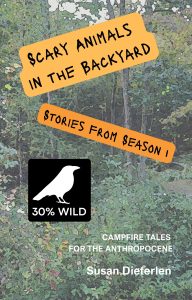
Every coyote, disappearing farmhouse, and Green Man,
Ready for a campfire near you
Plus “No Heroes,” a bonus story only in this e-book
The fascination of creepy places
Places we fear hold our interest. They are hard to be indifferent to. They’ve long interested me in a research sense, partly because fear matters in how we treat those environments, whether we avoid them or take care of them or try to pretend they aren’t there.
Sometimes we end up taking care of places *by* avoiding them, in that it can be the best thing for a natural area to have fewer people in it. Animals, whether scary or no, need wild places where we aren’t, and they don’t use the same metric that we do to decide whether a place is frightening. Bears don’t care that the woods looks just like the opening of that gothic thriller you watched last night.
Every once in a while, that works out well for wildlife, and a place we’re scared of becomes an accidental refuge for wildlife and nature.
Not everyone finds the same places scary, though. Not by a long shot. What frightens you is a window into who you are, your background, your experiences, and often your vulnerabilities. People tend to think we’re all the same in that regard, but we’re not at all. One person’s terrifying trail is another’s peaceful oasis, and vice versa.
All of this “spooky” talk is about *fear* in the woods. Not danger, which is different. Your head tells you, and your nervous system may tell you, as the adrenaline rushes through you and fight or flight kicks in, that fear and danger are the same thing, but don’t you believe it! Sometimes we’re afraid of situations that genuinely place us in danger. But we’re also afraid of all kinds of situations that aren’t genuinely risky. Just because you’re afraid doesn’t mean you are in danger.
I call this the “snakes and cheeseburgers” dynamic, in which loads of people fear snakes, which we are very, very, very unlikely to ever be hurt by, but we’re fine with diets that are very very likely, in a provable, evidence-based sense, to be pointing us toward actually deadly health problems.
It’s not the imaginary wolf that will get you as you run down the trail in the woods. It’s the sedentary lifestyle from *not* running or walking or bicyling or whatever. Or it’s the cars on the roads you take to the trailhead, or the emissions we’re all breathing from those cars. At a basic operating level, humans are bad at understanding long-term constant threats, even when we *know* those threats are deadly. We’re just not wired to fear them, or even to pay attention to them for long.
So fear isn’t danger. But also: just because you *aren’t* afraid doesn’t mean you’re safe, either. Unfortunately.
That brings us back to creepy places, and the nagging question in the back of our minds about whether we’re safe, or if we should listen to that fear in the woods.
Just enough fear keeps your attention, though, and if you pay attention, who knows what you’ll find out? It’s not *just* scary animals out there.
ANYTHING could be out there, somewhere off the path.
For more facts and figures about creepy places and our love for them, see “Fear in the Woods”
Prefer to listen rather than read?