

Radical idea: our places can be places for wildlife, too.
But radical ideas are just talk without specific actions.
Actions like:
- Cover the basics: shelter, water, food, spots to raise young. For prey *and* predators.
- Native plants everywhere. Or at least 70% of everywhere.
- Make sustainable design two for one by providing for wildlife, like rain gardens do.
- Accept the raccoon: cultivate the mindset that wildlife belongs where we live. Secure that garbage and grill!
- Spare space is dual purpose. Leftovers and lightly used spaces, like utility corridors, can go a little wild.
- Every road is a threat. We need crossings and slower speeds. Humans do, too.
- Shorelines and edges are wildlife highways. Preserve them.
- Embrace the dark. Less nighttime light is better.
- Intact habitat corridors are the emergency backup plan for wildlife.
- Normalize provisions for wildlife in green field development.
- Nourish your mind and body with the soul of the land. Saving wildlife saves us.
Episode 1.19: "How to (Re)Build Your World for Wildlife"
“30% Wild” podcast episode summary
You love wildlife and you want to do something to help it, but what can you do? If the problems facing wildlife look insurmountable, this episode is for you! Plus make a peaceful backyard refuge from everything else scary for yourself, a tiny vacation you can take daily. Learn how to make a difference, one backyard at a time, and (re)build for wildlife in the places where we live.
Take a trip into the past of your own neighborhood, and see the hidden world of your town, viewed as a fox or a bear.
A special how-to episode translating the insights of “Scary Animals in the Backyard” into pro tips and practical steps for your own local space. From real live landscape architect – creator and host Susan Dieterlen.
- Five ways to provide for wildlife in our space
- Four changes to make right now
- How saving wildlife saves us
- Changing what you can, and why it’s worth it
- Avoiding conflict with your local wildlife…and your neighbors
- Revisiting The Doom, and how to make a refuge from it
- Peace on demand is a potent tool for resilience to pretty much anything
- Help your neighbors love your backyard habitat – and want one of their own
- Fighting The Doom with small changes
The Complete Collection from Season 1
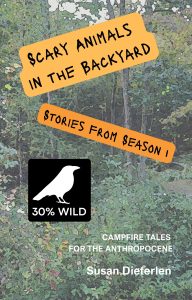
Every coyote, disappearing farmhouse, and Green Man,
Ready for a campfire near you
Plus “No Heroes,” a bonus story only in this e-book
Please scroll down to the bottom of the page for a full transcript of this podcast episode.
Online Course: How to (Re)Build Your World for Wildlife
Coming Soon!
Resources mentioned in the episode and other fun stuff
How-to tips for making a backyard habitat/tiny vacation:
– Add a place for you in the habitat, whether inside looking out or within the habitat itself.
– Turn off extra lights and use timers and motion sensors to minimize light from what you keep.
– Provide a water source, and consider how it sounds and looks to you.
– Minimize disruptive and unpredictable noise. White noise is OK.
– Get some distance from people, if possible, or at least make it hard to see them.
– Make your habitat look good to your neighbors by adding a backyard habitat sign, keeping a tidy edge, adding a decorative fence, and/or other ornaments like birdbaths.
More from “30% Wild” in these related episodes:
For much more about native plants in your habitat/refuge AND about health benefits from nature, check out “Back from the Dead, aka Rewilding“
For more about terminology about native and invasive species, check out the “Snakeheads and Sharks, Part 1,” episode
For more about how to stay safe in bear country, including with pets and in your backyard, take a look at “Bear-anoia“
For more about awe and what it does for us, go to “Impossible Scary Animals: Seeing What’s Not There.”
For more on how turning off extra lights helps wildlife, see “Big Bad (Imaginary) Wolves” and “Ravens and Raptors“
For more about The Doom, go back to “Introducing 30% Wild: Scary Animals in the Backyard,” the very first episode!
Vision Zero, about making our roads safe for pedestrians and bicyclists – and also people in cars
Impact on wildlife from free-roaming outdoor pets
More about accidental nature that shows up behind our backs due to unintended consequences, a big theme of Design by Deficit: Neglect and the Accidental City
Margaret Mead, a famous and very influential American anthropologist of the 20th century
Peer effect, in this case, regarding solar panels in residential neighborhoods
Health benefits, including mental health, from nature: “Wild and Healthy: Urban Nature at Work for Mental Health and Climate Action“
Health benefits of meditation: https://www.healthline.com/nutrition/12-benefits-of-meditation
Backyard habitat programs and certification
https://certifiedwildlifehabitat.nwf.org/
Including the 70% native plants rule
https://www.bhg.com/gardening/design/nature-lovers/create-a-backyard-wildlife-habitat/
Credits:
Chime sound effect by WeVideo
Theme music by Lost Harmonies
Raven audio recording by Tyler Hulett
Other music by Alitu.
Full transcription of podcast episode
[00:01] Susan: Look around you.
[00:03] What was the place? You see your yard or street or parking lot centuries ago,
[00:09] before settlement or development.
[00:12] List what’s here now that wasn’t then. Go ahead. You can do it out loud. I won’t listen.
[00:18] Is it streets,
[00:21] buildings? How about that? Lawn,
[00:24] flower beds, traffic lights? It’s going to be a long list,
[00:28] so pause it here if you need to.
[00:31] Now do the opposite. What’s missing now that was there then?
[00:38] This is harder, but use your imagination and fill in the blanks. And again,
[00:43] pause it if you like.
[00:46] Say you guess your apartment complex was forest 300 years ago.
[00:51] What had to be removed to change it from forest to what you see today?
[00:56] If you stood in that primeval forest and you waved a magic wand and instantly changed the scene around you to what you see today,
[01:05] what would disappear?
[01:07] Well, if it was forest, trees disappeared. But it’s not just the trees.
[01:13] Fallen logs, branches, all the natural litter that makes a forest floor. All gone.
[01:19] Maybe ground was leveled or shaped to allow paving in buildings.
[01:23] All the other plants of the forest were scraped off and removed. All the wildflowers and shrubs and seedlings.
[01:31] Forest pools, the kind that fill in wet weather and drain in dry.
[01:36] Those are gone now.
[01:37] And the rainwater soaks into the lawn or it swirls down the storm drain.
[01:43] What else is gone?
[01:45] The wildlife.
[01:46] All the creatures who once lived there, around where you now stand, are gone. Or almost all gone.
[01:54] If you think there are scary animals in the backyard now, you should have seen your yard 500 years ago.
[02:01] Why did we do all that?
[02:04] Why this transformation?
[02:06] It didn’t happen by accident.
[02:09] Construction and land development is a lot of work.
[02:12] A lot of work by a lot of people. People like me back when I used to do design and construction observation as a practicing landscape architecture.
[02:21] Every step of that transformation from forest to your street happened on purpose.
[02:27] It happened according to an agenda.
[02:30] And what was that agenda?
[02:32] To make wild North America safe and comfortable and marketable to us.
[02:40] To make it habitat for humans like us,
[02:43] those of us who live here now.
[02:47] What if that wasn’t the agenda?
[02:51] What if we made places like your street or yard for wildlife?
[03:00] I’m Dr. Susan Dieterlin and this is 30% wild. Scary animals in the backyard.
[03:06] Listen. Subscribe and support 30% wild@30wildpod.com that’s T H I R T Y wildpod.com a radical idea. Possibly even a subversive one.
[03:23] Our places can be places for wildlife,
[03:27] too.
[03:29] But radical ideas are just talk without specific actions.
[03:35] This episode is a how to episode, which makes it different than most of the episodes this season.
[03:40] The big idea here is that I, a landscape architect, or at least that’s what I started my career as,
[03:46] am taking this whole scary animals thing and translating it into actionable steps and advice for what you can do in your own local space, maybe even your backyard.
[03:57] If you want pro tips, you go to a pro.
[04:00] In this case, a pro in shaping physical space and how we use it.
[04:06] So here they are, those pro tips,
[04:09] five ways to provide what’s needed for wildlife in our space.
[04:14] You cover the basics. Shelter, water, food, spots to raise young, for predators and for prey.
[04:22] This is really about putting on a different set of eyes, so to speak, and viewing the land where you live, like a gray fox or a little brown bat.
[04:30] What’s the bat’s eye view of your street?
[04:33] Give that a try. This week, as you go about your daily routine, look with new eyes at that supermarket parking lot or the route between your job and your home.
[04:42] What does a bat see there? Is it safe and welcoming? Is it a forbidding wasteland? What makes the difference?
[04:49] Brace yourself.
[04:51] Food, in this case,
[04:53] often means other wildlife, because not everybody is at the bottom of the food chain.
[04:59] Many bigger, more charismatic species, which means the ones we see more easily and usually the ones we get more excited about are actually at the top of the food chain, just like we are.
[05:10] Food can mean plants or ants, but it also sometimes means rabbits or birds.
[05:17] Know, though, that predators doing their thing, eating and hunting prey doesn’t equate to wiping out that prey.
[05:25] Having coyotes or hawks around does not mean you don’t have any rabbits, because a predator that wipes out its prey is a predator that is queuing up its own extinction.
[05:36] Balance is the goal. That’s what healthy ecosystems are all about.
[05:42] You need native plants everywhere, or at least 70% of everywhere.
[05:48] You can have wildlife around with plants that aren’t native, but you really need plants that are native, which means indigenous to the land where you are, to get very far into making a place for wildlife.
[06:00] Because those plants are the foundation, and nothing stands without the right foundation.
[06:06] That foundation is what the insects eat, that the birds eat, that the bigger predators eat.
[06:11] The rule of thumb is at least 70% native, so that means you can have your daffodils or tomatoes or lilacs, but you want to balance them out with a wildflower area or planting some oaks.
[06:22] Again, it’s balance.
[06:25] Native plants, though, they come with some pretty amazing other advantages, like often being less work and frequently being just tough as nails because they’re Suited to being where you are.
[06:36] You can learn a lot more about that in the 30% wild episode Back from the Dead, aka rewilding. And if I have just lost you in these terms, native and invasive,
[06:46] check out the Snakeheads and Sharks Part 1 episode for definitions of those.
[06:53] Shorelines and edges are wildlife. Highways preserve them.
[06:59] Edges where different habitats overlap have more going on for wildlife, so they are particularly valuable. Water courses like streams or shorelines make good travel corridors too, since many animals won’t swim if they don’t have to and others don’t want to stray too far away from the safety of water.
[07:15] Some predators like high points and ridges to see who’s coming and going around them.
[07:21] You put this together and you can get a whole map of an area,
[07:25] like an alternative geography through the eyes of a fox or a deer.
[07:30] There’ll be more about that in a moment, but for now,
[07:33] know that it’s important to protect these travel routes and corridors of vegetation along them.
[07:38] It is important in part because those intact habitat corridors are the emergency backup plan for wildlife.
[07:47] Everybody needs an escape route when things go wrong.
[07:52] And things are going wrong.
[07:55] Just like the changing climate is beating us up, it’s beating up on wildlife. But it’s a lot worse.
[08:02] Habitats are becoming less hospitable,
[08:04] more extreme, hotter, drier, or wetter, more salty. As sea levels are rising,
[08:10] food sources are suffering. In many cases,
[08:12] diseases are appearing or worsening, which is also happening to us. And invasive species are spreading.
[08:20] Plus, we’re pushing around wildlife in ways beside the big climate emergency, like moving into wild areas,
[08:27] pushing the edge of where we live more into wild land. That’s a long term trend that’s picked up steam recently.
[08:35] There’s also the same old, same old of habitat destruction. Things like cutting forests, draining wetlands and bulldozing grasslands for development.
[08:42] Habitat fragmentation and dead end corridors mean that there’s nowhere to run,
[08:48] making all of these impacts worse.
[08:52] Every road is a threat.
[08:54] We need crossings and slower speeds and humans do too.
[09:00] I am not going to lie to you.
[09:02] Cars are a huge problem for wildlife, as you’ll recognize if you have ever seen roadkill.
[09:09] It is hard to make all the streets safer, but it’s not terribly difficult to make a single short street safer. You can, for example, line it with fences, guardrails or other barriers.
[09:21] While many animals can readily get over, under, through these barriers,
[09:26] they, like us, tend to take the easy way when they can, which means going around a barrier. So you put breaks in those barriers where it is safest for wildlife to cross.
[09:35] You need good sight lines in both directions or maybe places where traffic is already slower.
[09:41] You put shelter for wildlife, like brush or canopy trees on either side of that crossing.
[09:47] And if you’ve heard of any of these strategies, it’s probably wildlife, bridges or tunnels, because they get a lot more press.
[09:54] These can work well if they’re designed thoughtfully and correctly, but they are expensive, and they also usually require permitting to build, so they’re not a panacea, or at least not a quick fix.
[10:05] Ultimately, the safest road for animals is also the safest road for people,
[10:11] which means as few motorized vehicles as possible, going as slowly as possible with the most attentive drivers possible driving with a mindset of yielding the right of way, especially to anything not encased in a metal box.
[10:26] We don’t like that idea very much, at least those of us with cars.
[10:31] Wild creatures do sometimes use roads to hunt or as open paths to walk on.
[10:37] Birds will use quiet roads as a source for grit. They eat to allow their gizzards to break down food.
[10:44] Many creatures also like the residue from winter salting of roads, which is a good source for the salt they need, but also a good source for creating roadkill changes. Start with us.
[10:59] The good news there is that us,
[11:01] in this case can be me and you.
[11:04] You right there listening to this.
[11:06] We don’t necessarily need some big, authoritative, powerful version of us to get on board to make a start.
[11:17] We, you and me, can change how we do things with actions like these four tips.
[11:25] Accept the raccoon Cultivate the mindset that wildlife belongs where we live, which means you secure that garbage and grill.
[11:36] Know what lives around you so it’s not an emergency every time you see an animal. Sure, you live in Missouri. A polar bear walks by your window. Call somebody about it.
[11:44] Maybe call everyone you know about it. But a fox or a coyote? They’re just your neighbors. Be a good neighbor and avoid conflict with them by being smart about how you manage things like your garbage, like pet food, compost piles and grills.
[12:00] And think about where your pets are and who else is around them.
[12:05] Your pets know they’re part of nature, but they may not realize that they can get into all kinds of trouble.
[12:11] Some of that is deadly trouble with your wild neighbors.
[12:15] And sometimes our furry friends can be the deadly ones themselves.
[12:20] Decide what parts of your space you’re okay with wild critters sharing and what parts you are not.
[12:26] Most people want to be the only creatures inside their homes with their pets,
[12:31] but many of us are okay with the occasional mouse and the inevitable spiders in the garage.
[12:37] You might welcome songbirds on your porch, but really prefer that raccoons stay in the yard.
[12:44] Most gardeners want deer and rabbits out of their garden areas.
[12:48] They’re probably not going to get that, but they want it.
[12:51] Whatever you decide, even just thinking about it makes mental space for wildlife.
[12:57] And practically speaking, it points you toward the steps you need to take to keep critters out of the spots you don’t want them in, while revealing that it’s really okay with you to share other spots with them.
[13:11] Embrace the dark.
[13:13] Less nighttime light is better.
[13:16] You can add welcoming wildlife to the host of reasons not to indiscriminately flood the night with light.
[13:22] Artificial light is notorious for disorienting and disrupting birds, but it also makes other wildlife uncomfortable with an area.
[13:30] We like light and fear darkness because we use sight to navigate the world, among probably a lot of other reasons.
[13:36] But most wildlife uses hearing and smell to navigate with that perspective. Darkness is a protection, not something to fear, and artificial light is an intruder.
[13:49] You can make sustainable design 2 for 1 by providing for wildlife in the way rain gardens do.
[13:57] What wildlife needs sounds a lot like the big list of what we need to live more sustainably,
[14:03] what we need to do to stop or at least survive extreme weather or other smaller environmental goals like stormwater management.
[14:11] There’s plenty of common ground here, and we can certainly act to do one or more of those things while we make a place for wildlife.
[14:20] Like for example,
[14:22] building a rain garden with deep rooted plants native to wet prairie or wetlands. That makes more rainwater infiltrate into the ground where we need it. It lessens flooding from extreme weather and also counteracts water pollution.
[14:34] It locks up more carbon in the plants and their roots and the soil they enrich, which is the basic climate action that we so much need.
[14:42] But at the same time,
[14:43] that rain garden is providing habitat for insects, butterflies and a few birds. It’s two for one. See,
[14:50] not every project or policy done to make our world and lives more sustainable automatically creates better habitat for wildlife like this. It doesn’t usually happen by accident,
[15:02] except when it does through accidental nature that shows up behind our backs due to unintended consequences. What I call design by deficit. And you know, there is a lot more about that in the episode Notes Speaking of design by deficit,
[15:19] spare space is dual purpose.
[15:22] Leftovers and lightly used spaces like utility corridors can go a little wild to make places for wildlife. We need space to do it, which usually means space we humans can spare.
[15:35] Wildlife needs huge wild Areas like nature preserves and national wildlife refuges and national parks and monuments.
[15:45] But also we take up a lot of space that we don’t actively use.
[15:51] Buffers, space for future expansion, brownfields. Land we only use overhead, like high voltage power lines or parts of airports.
[15:59] Land we only use underground, like gas line corridors.
[16:03] Land we only use in case of emergency, like runaway truck ramps on interstates or detention areas for floodwater.
[16:11] What happens if we rethink all of this spare space as dual purpose?
[16:16] It can do all those things we need it to, but it also provides more space for wildlife.
[16:23] Maybe that’s not wolves, probably. But how about songbirds or bees?
[16:28] It can be as simple as maintaining that utility corridor in ways that promote native grasses instead of invasive shrubs like honeysuckle,
[16:36] which can be just how often you mow, or at what height, or whether you might be able to do a controlled burn there every couple years.
[16:44] It can even just be about not mowing during the nesting season for ground nesting birds.
[16:50] My final tip here is also a pro tip. But in this case it’s not just from a pro,
[16:57] but it’s directed at pros. Those of you listening who are in architecture, planning, development or construction, but that also includes people on local boards and clients. So that’s actually an awful lot of people.
[17:09] Normalize provisions for wildlife in greenfield development.
[17:14] Quick note. Greenfield development means you’re developing a piece of land that didn’t have buildings on it already.
[17:22] We know how to make places work better for wildlife.
[17:26] Just a couple examples. There’s soft landings under trees we can remander channelized streams.
[17:32] And of course those wildlife road bridges and tunnels. That’s just a start.
[17:37] This is a good place for a reminder. And if you have followed my work, it is a regular reminder that our physical surroundings, the human dominated landscape and buildings around us,
[17:48] do not naturally occur. They don’t just grow like this.
[17:52] We made them so we can change them.
[17:56] They’re malleable. Just like every system and organization.
[17:59] We humans create all of those projects for wildlife. They happen in the same way that we build anything. The same way that we build houses or airports, for example.
[18:11] We know exactly how to shape the world. We just need to do it with a different goal.
[18:17] Using all our abilities and tools that develop land,
[18:21] that whole kind of machine or industry.
[18:24] We can make it not into strip malls and subdivisions and highways, but into instead into woods and wetlands.
[18:33] The whole industry of land planning, design, development and construction is not inherently anti wildlife.
[18:40] That industry works toward the goal that we pointed at.
[18:44] If that goal is condos and strip malls, that’s what you get. But if it’s meadows and wetlands, you get those instead.
[18:52] You may say that that is impossible. Well, I want to say to you that there was a time back when I started in landscape architecture, a long time ago,
[19:03] when no one built places for people in wheelchairs. And then that became business as usual, and now it’s everywhere.
[19:10] There was also a time a little bit later when any kind of sustainable design was weird and niche and too special for you to actually get in anything that you were building.
[19:21] But now it’s a pretty ordinary consideration in building things, even if it’s not yet the way that everything is built.
[19:29] And that’s not even getting into how we used to do everything without the Internet. And now it’s a part of everything, and we all adapted to that.
[19:38] Things change.
[19:41] They change all the time.
[19:43] The usual in business as usual changes.
[19:48] This could too.
[19:49] We just have to change it.
[19:52] It’s worth it to change,
[19:54] because saving wildlife saves us.
[19:59] Nourish your mind and body with the soul of the land.
[20:04] Our bodies and minds benefit from being around nature in a bunch of ways documented by science.
[20:10] Wildlife is a key part of that.
[20:13] A chorus of birdsong or the glimpse of an eagle can pull us out of our everyday lives and stresses, granting us a moment of awe that doesn’t just lower our blood pressure and cortisol levels, it feeds our souls.
[20:28] It’s harder to capture in research findings, but our cultures and spirits are sustained by nature.
[20:34] Wildlife is a powerful part of that.
[20:37] It’s worth remembering how very new the world that we live in today is that we are spending our days in surroundings totally created by human hands and machines.
[20:48] With time in nature being an exception or luxury.
[20:52] As recently as a generation or two ago, the opposite was true.
[20:56] We live surrounded by wild things and spent most of our time, maybe all of our time, every day, outdoors or in shelters so minimal that the outdoors was always close at hand.
[21:08] Not many of our spiritual or cultural traditions are as new as that digital device you’re holding in your hand or the Internet. It connects to those traditions that ground us and make us who we are.
[21:24] Almost always connect to that older world where nature was the constant and we were very small within that world.
[21:35] Nature is the soul of the land where we live.
[21:39] There’s no substitute for the deep connection to your own place that you get from knowing and seeing your local wildlife.
[21:47] We live in an era marked by disconnection, friends,
[21:51] by alienation and loneliness.
[21:55] Maybe being more at home on the land where you Live is something of an antidote to this,
[22:01] a remedy to the homesickness for a place you’ve never been.
[22:06] It’s a false frame to see it as either or as us or them.
[22:13] We can all thrive together and knit our communities into healthy places for a better, more stable future for everyone.
[22:24] Making places for wildlife saves us too.
[22:36] What’s on your mind today?
[22:40] Everybody’s got a worry. Or six.
[22:42] What’s your top one today?
[22:44] Or maybe your top seven?
[22:47] Who couldn’t use a refuge,
[22:50] a place to find some peace and a respite from the incessant mayhem of the world?
[22:57] Whatever your top worry is today,
[23:00] we have all got that in common. That we’re concerned, agitated,
[23:05] maybe full on freaked out about something happening in the world today.
[23:10] You might think it’s just people like you or people where you are, but it’s not. It’s all of us. And we are not the only ones.
[23:20] The wildlife around you maybe doesn’t worry like we worry, but wildlife has some real troubles. As in existential, will I survive this decade troubles.
[23:31] In short,
[23:32] wildlife needs a break.
[23:34] Let’s give them one.
[23:36] How about in your backyard?
[23:39] What good could that do? I hear you saying I just have a backyard, not a potential wildlife refuge. Maybe you don’t even have a backyard. Just a balcony or patio or the backyard you have as your landlord’s and not someplace that you can wholesale renovate while changing what you can,
[23:57] where you can can have a big impact.
[24:02] What’s small to you can mean the world. To those in danger,
[24:06] whom your actions protect.
[24:08] To those butterflies or turtles.
[24:11] It’s worth saving some things even when you can’t save everything.
[24:17] Especially when you can’t save everything.
[24:22] Your small changes can make those around you more motivated to make similar changes. Small changes.
[24:28] This is a real phenomenon shown by research into something called peer effect.
[24:33] But you’ve seen this for yourself in your own life.
[24:36] Watch a classroom of kids.
[24:38] See how when one does something, others pick it up and soon the whole room is doing it. Sometimes that’s positive. It’s very often negative.
[24:46] We used to call this monkey see, monkey do. But it’s not just kids or monkeys.
[24:51] Adults do it too.
[24:53] We just call it pure effect because that way we don’t sound so much like copycats or copy monkeys. I guess your small changes don’t work alone.
[25:04] Your tiny backyard habitat patch is like a rest area along a highway.
[25:09] That highway is all the other green spaces nearby. Whether intentional or not,
[25:16] they work together to improve habitat connectivity and counter fragmentation.
[25:22] The rest stop of Your backyard can be what gives that songbird and other exhausted travelers what they need to keep going.
[25:32] It’s not obvious and you may not see it,
[25:35] but when we work together,
[25:37] all those little individual actions can add up to big impacts. If you were alone and acting, sure, it wouldn’t make a big difference. But you are not alone.
[25:49] You’ve got plenty of company.
[25:52] You’re not so much embarking on a tiny, too small to matter endeavor as you are lending a hand to a huge,
[26:00] well worthwhile movement.
[26:02] But also your little backyard habitat makes a better habitat for you.
[26:10] It makes you a version of you you would very much like to be more often a calmer, more relaxed, more peaceful you.
[26:20] Having a place for wildlife just outside your door builds in a mental health break in your own life.
[26:27] Like a tiny vacation you can take daily,
[26:30] this kind of potent stress relief adds up in your health.
[26:34] It can even make us feel more at home on and connected to the land where we make our home.
[26:41] You all remember the doom, right?
[26:46] If this isn’t ringing a bell,
[26:48] hit pause and go back and listen to the very first 30% wild episode introducing 30% wild again.
[26:56] But you know the doom whether you realize it or not. It’s the message we get that big scary things are happening and nothing we do will matter.
[27:09] That all you can do is cower under the bed and hope to hide as long as possible.
[27:14] Or maybe just tune out entirely and learn to ignore the dread in the pit of your stomach. Because the doom is loud and it is tough to shake.
[27:26] At the start of the season, the doom was about climate and the overwhelm and fatigue of the daily, sometimes hourly stories we hear about another catastrophe and another harbinger of apocalypse.
[27:37] It is easy to feel hopeless about extreme weather,
[27:42] but maybe there’s other dooms in your life too.
[27:46] I could list a few things,
[27:49] but if you’ve got overwhelming worries that make you feel helpless, you don’t need me to call them to come crowd around you. Those worries are already there. They’re kind of always there.
[28:00] Here’s the good part. That backyard wildlife habitat. It can be a place for you to step back from the doom and catch your breath.
[28:11] It does this at the same time that it gives the birds and the bees or whatever you are interested in, a spot to rest and recover. A kind of multi species breather.
[28:24] And it is very easy to get this calm.
[28:27] In fact, it’s no effort at all because we do it automatically. You sit and observe the wildlife and the nature and that observation is like meditation.
[28:36] But Wait, there is more good news.
[28:39] That moment of respite, staring at the butterflies, doing butterfly things,
[28:44] it makes you healthier.
[28:47] A place to escape the doom,
[28:49] makes you more resilient to whatever.
[28:53] And that might even head off some other future dooms.
[28:58] There’s a long list of health benefits from spending time in nature, like your backyard habitat. And yes, that’s backed by science. Plenty of it.
[29:08] Those include mental health benefits like easing depression and anxiety and fighting some of our deadliest chronic diseases, like heart disease.
[29:17] Being calm in your habitat is a lot like meditation. And meditation, too, has some very appealing health benefits, like better sleep and lowering blood pressure.
[29:30] These, too are backed by science, which are my very favorite kind of health benefits.
[29:36] These are all impressive ways to say a simple truth that it is good for us.
[29:42] It can even be life changing to find a way to calm down.
[29:49] This is never more true than when the doom has its claws in you.
[29:56] Whatever comes,
[29:58] we face it better with this calm place on our side.
[30:04] Peace on demand is a potent tool for resilience, resilience to more or less anything.
[30:11] So take a deep breath,
[30:14] then exhale,
[30:16] and let’s proceed calmly into how we accomplish this miracle. Right in your own backyard,
[30:31] imagine that you aren’t just a human interested in helping out your chosen creature, but rather that you are that chosen creature.
[30:39] What does your backyard look like from the viewpoint of a bluebird or your street? To a fox or your neighborhood to a bear?
[30:48] Through the eyes of a bluebird or a fox or a bear? Your neighborhood isn’t just the same old streets and houses. Or rather, it is.
[30:56] But those streets and houses fade into the background. They’re the negative space, not the features.
[31:02] There’s an alternative geography of the places you spend your life,
[31:06] full of waypoints and pathways, threats and safe harbors that you never see or even realize are there.
[31:14] Sit with that a minute.
[31:16] It’s made of green spaces, sheltering shrubs and trees, food sources like fruits and grass, seeds, water for drinking and shelter.
[31:25] All the scale is different according to the size and speed of travel of those new eyes.
[31:31] To a salamander, crossing, a quiet residential street is a dangerous, epic journey.
[31:36] To a coyote, that same street is a convenient path to jog along whenever no humans are watching.
[31:44] To a bird, that street may not even be worth noticing because the bird is swooping from tree to tree overhead.
[31:51] The connectivity that matters to them is habitat. Connectivity patches that connect to form corridors and routes to migrate or places to stay.
[32:01] The overgrown lawn of the abandoned house down the street,
[32:04] that’s the best Place around now,
[32:07] not a nuisance.
[32:09] Your neighbor’s immaculate weed free lawn,
[32:13] a wasteland of toxic residues.
[32:16] No food, no water, nowhere to hide.
[32:19] Nooks and crevices under porches and sheds are now the most important safe places. While the houses themselves are unimportant. It’s just something to navigate around.
[32:30] See what just happened.
[32:32] While you were busy being your critter of choice and seeing the town through their eyes, you weren’t worrying about your own problems.
[32:40] This kind of escape, it feels like being in a whole other world.
[32:45] Something called extent in environmental psychology,
[32:49] that sense of being away restores our minds and it actually lets us function better,
[32:55] maybe even function better to handle those problems and take on the doom.
[33:02] It’s one part of why it’s so beneficial to us to watch wildlife. It takes you out of yourself,
[33:09] seeing a life utterly unconcerned with your own troubles. And just for a moment,
[33:15] you too are fluttering among the flowers or gliding through a field far from the rent or the boss or whatever the news is today.
[33:25] To make this miracle,
[33:27] add a place for you in the habitat.
[33:31] A spot to sit and observe. Maybe through a window from inside, maybe outside, looking into your habitat. Ideally both.
[33:38] So it’s year round and independent of weather.
[33:41] Seeing what’s happening in winter or rainstorms can actually improve how you feel about your least favorite kind of weather.
[33:48] And turn off those extra lights, use timers or motion sensors, and use light fixtures that only shed light where you need it, not beaming up into the sky.
[33:58] We need darkness to set our internal clocks to sleep and wake. And wildlife needs darkness too, as we’ve heard this season about wolves and birds.
[34:08] It sets a great scene for using candles or mood lighting as well.
[34:13] Wildlife needs water, so provide some.
[34:16] You and I need water too, including for its soothing restorative sound and the way it looks.
[34:22] Even a tiny bird bath or dripper or butterfly puddler can work.
[34:28] In a perfect world, your habitat would be silent, save for the sounds of nature,
[34:33] birdsong and the wind through the trees,
[34:36] maybe a single perfect wind chime.
[34:39] But this is not a perfect world. It’s far from it.
[34:43] And most of us live with noise that we don’t make and we can’t control.
[34:48] So do what you can to minimize this, especially noise that’s disruptive and unpredictable.
[34:54] Constant hums or drones, things like traffic or air conditioners that is less of a problem.
[35:00] Even if they’re loud. It can actually give you white noise that blocks everything out and makes it seem quieter.
[35:07] It will not be news to you that people can be a big source of noise and disruption, even sometimes people we like.
[35:16] You want to minimize that in your backyard habitat, not just for you, but for the wildlife you’re welcoming.
[35:22] Where you put your habitat, who you can see from there, and who can see you are key to this.
[35:29] Often when we can’t see the source of a sound, the sound seems quieter and less important.
[35:36] It’s not quieter, but it can seem quieter.
[35:39] So use that toward this end.
[35:42] It is a big help to set your neighbors up to see your new backyard habitat as good,
[35:50] beneficial, or at least not something to complain to you about.
[35:54] There’s a couple research based tips for this to make passersby more likely to see natural landscapes like yours positively,
[36:03] we can put up a sign identifying this as a backyard habitat in progress. And you can do that at the very beginning when it still may look like it’s kind of a mess.
[36:13] Keeping a tidy edge by mowing, edging, or using pavement or a pathway,
[36:20] that little thing helps a lot to make your site look more acceptable to other people.
[36:26] A fence, even just a decorative one, helps too.
[36:30] Or other built elements like bird baths or one piece of yard art, something like a bench maybe.
[36:38] The more people view your habitat as positive, the more those people are likely to create their own peaceful haven for wildlife in themselves.
[36:48] And one haven is good.
[36:50] But a whole neighborhood or an entire city full of backyard habitats is so much better for all of us.
[36:59] Take yourself to 30wildpod.com and you can get links there to learn more about all of this.
[37:07] And take this with you.
[37:10] We can’t change everything,
[37:13] not as individuals.
[37:15] But we can change what’s around us,
[37:19] the bits that touch our own lives, that are in our control. And we can spread the word to those around us who might want to do the same.
[37:28] Our changes. This shaping can link up with the changes of others, like habitat connectivity and form an archipelago of oases,
[37:38] a constellation of lights showing the way through the darkness,
[37:43] the darkness of the doom around you.
[37:47] As anthropologist Margaret Mead is said to have said,
[37:51] never doubt that a small group,
[37:55] thoughtful, committed citizens can change the world.
[37:59] Indeed, it’s the only thing that ever has.
[38:04] There’s rest and renewal awaiting you and the wild creatures around you.
[38:10] What have you got to lose?
[38:14] For a lot more about how your plant choices make or break backyard wildlife habitat,
[38:20] check out the Back from the Dead, aka rewilding episode of 30% wild in season one.
[38:28] Scary animals in the Backyard.
[38:30] Spoiler alert. It’s all about the native plants.
[38:39] 30% wild. Scary animals in the backyard is created by me, Dr. Susan Dieterlin, and is a product of Deft Space Lab.
[38:46] All parts of this podcast are copyright protected and may not be duplicated or used without express written permission by the creator.