

Episode 1.18: "Impossible Scary Animals: Seeing What's Not There"
Find us where you listen to podcasts at thirtywildpod.com
“30% Wild” podcast episode summary
What is it we see, when what we see is “impossible”? Have you ever had something unsettling happen in the woods that you couldn’t explain? Whether animals way out of place, cryptids, or mysterious noises and lights, we wander through the possibilities of what’s going on when you can’t believe what you see.
We also take a nighttime stroll through a legendary woods where everything depends on the eye of the beholder.
With snippets from here and there, including the guests on our previous episodes, about being “unsettled” by the impossible, out there.
- False wildlife reports, and what’s behind them
- Perception vs reality
- Imagination and seeing what you want to see
- The need for awe
- Hoaxes through the ages
- What your brain wants you to see
- A real true ghost story
- Cryptid or creature?
- What unsettles experts out in the woods
- Includes the original story, “Beasties”
The Complete Collection from Season 1
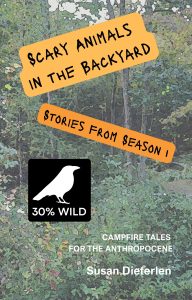
Every coyote, disappearing farmhouse, and Green Man,
Ready for a campfire near you
Plus “No Heroes,” a bonus story only in this e-book
This Episode’s Guests
Thanks to all the “30% Wild” guests whose interviews were excerpted in this episode:
Dani Freund from the Voyageurs Wolf Project
Brian Roell from the Michigan Department of Natural Resources
And Dr. Rochelle Sturtevant from
NOAA’s Great Lakes Aquatic Nonindigenous Species Information System
You can hear much more from each of them on this season’s episodes,
Big Bad Imaginary Wolves
Mountain Lions in the East, parts 1 and 2
And Snakeheads and Sharks, parts 1 and 2.
Please scroll down to the bottom of the page for a full transcript of this podcast episode.
Possible Perception or Impossible Reality?
Read all about it:
Just because you’ve seen it, can you believe it?
This page may include affiliate links. Buying through them adds *no* additional cost to your purchase, supports “30% Wild,” and supports independent bookstores via Bookshop.org. What a deal! Thanks so much for your support!
Resources mentioned in the episode and other fun stuff
Perception vs Reality:
The video with the Gorilla that people don’t see
Commentary on the gorilla video, why some of us see it and some of us don’t and what that means for real life (driving! Motorcycles! Cell phones!)
Eyewitness testimony about crimes is surprisingly unreliable, and a big part of why DNA evidence has been instrumental in overturning wrongful convictions: https://www.scientificamerican.com/article/do-the-eyes-have-it/
More about two Scary Animals that often go unseen and unnoticed, or even mistaken for a different Scary Animal: Legend of the Fisher (Cat) and Apocalypse Pork: Feral Pigs
We want to believe
“Wild Thing” podcast, Season 1, Episode 9, “Why We Want to Believe.”
Confirmation bias: What is it, why it’s a problem, and how to keep yourself from falling for it
Awe:
The decline of religious affiliation in the US
Hoaxes:
Frozen shark in Lake MIchigan hoax: Snakeheads and Sharks
Cardiff Giant, including where to see it today
Morton the Nantucket Sea Monster and parade balloon
Great Salt Lake Whale hoax, the original newspaper articles from 1888
The creator of “Birds Aren’t Real,” a satirical conspiracy for the age of online mis/disinformation: https://hub.jhu.edu/2024/02/07/birds-arent-real/
Heuristic toward seeing faces:
Why we see faces in nature:
https://hub.jhu.edu/magazine/2024/winter/pareidolia-faces-in-nature/
Guilt, or the 1970s Bigfoot cultural moment:
Bigfoot song, 1973: https://youtu.be/6gdwBSOBzqs
And this groovy classic, “Bigfoot,” from 1976
Movie: 1972 “Legend of Boggy Creek” https://www.imdb.com/title/tt0068837/
“Environmental Crisis in the Late 1960s,” including the Cuyahoga River catching fire and the horrific smog in cities
1970s Environmental Movement
Round-up of Bigfoot toys from the 1970s, which you owe it to yourself to see
The classic book that inspired the modern environmental movement: Silent Spring, by Rachel Carson
Your Impossible Brain
Read all about it:
How many sightings are exactly this: seeing an animal in a totally unrelated object?
Credits for the original story, “Beasties,” included in this podcast episode
The very short story, “Beasties,” is an original work by me, Susan Dieterlen.
It is inspired by folklore and reports, brand new and very old, about what we see out there, whether cryptid or wildlife or something in between.
These include:
Bears, especially where black bears are recolonizing new territory OR the #1 cryptid him/herself…Bigfoot
Barn owls, feral cats, raccoons, and/or red foxes screeching OR the Mexican and Mexican-American legend of La Llorona and her Irish cousin, the banshee
Barred owls and/or sandhill cranes a-swooping around in West Virginia OR Mothman
Those barn owls, feral cats, raccoons, and/or red foxes screeching once again OR the widespread legend of Cry Baby Bridge
Gray wolves on the move from the northern Great Lakes OR Wisconsin’s own Dogman, aka the Beast of Bray Road
Those chilling barn owls once more – seriously, listen to this cry – silently hunting on the wing OR ghosts, phantoms, and so on.
Also a brief quote from the traditional Scottish prayer, full text here: https://sites.pitt.edu/~dash/bump.html#prayer
Credits:
Theme music by Lost Harmonies
Raven audio recording by Tyler Hulett
Other music by Alitu.
Full transcription of podcast episode
[00:00] Speaker A: Not far from you, a narrow road winds through the woods. A lonely route where you’re never alone.
[00:08] Or are you?
[00:10] Creatures cross at the periphery of vision. Too quick for a good look, but too real to be imaginary.
[00:17] Who will keep you company should you travel by night?
[00:22] One is too tall, dark and shaggy. A a powerful stench, A blur in the photographs, leaving only tracks.
[00:31] Another has a haunting scream. A figure in white with long flowing hair just at the edge of your vision near the deserted crossroads.
[00:42] One swoops high over the road,
[00:45] red eyes aglow, searching for tragedy or perhaps searching for prey.
[00:53] One reveals nothing at all to the eye, but just crying,
[00:58] inconsolable.
[01:00] In the shadows below an old,
[01:03] old bridge.
[01:06] Another lopes by, pointed ears and snout, impossibly fast on two strong legs.
[01:14] A ghostly wail and a lost soul screech.
[01:18] Something pale and floating,
[01:20] sweeping silent through the night.
[01:24] Good Lord,
[01:26] deliver us.
[01:28] Deliver us from impossible creatures.
[01:36] I’m Dr. Susan Dieterlin and this is 30% wild scary animals in the backyard.
[01:42] Listen, subscribe and support 30% wild@30wildpod.com that’s T H I R T Y Wild.
[01:54] Speaker B: I was out there and I was just, you know,
[01:56] today might be the day I find a dead body out here. I would just let these scary movies kind of really frighten me and while I was in the forest and just really be on edge,
[02:08] which then. And all of a sudden you start to see random stuff like at the edges of your mind because you’re like letting your imagination run away with you.
[02:16] I still have days like that where I’m like, today’s a creepy day out here in the woods. Sometimes I listen to it and sometimes I don’t just because I think sometimes it’s good to trust your gut, depending on the situation, particularly if you’re out in the wilderness by yourself.
[02:34] Speaker A: Have you ever had something unsettling happen in the woods that you couldn’t explain?
[02:40] Well,
[02:41] have you?
[02:43] If I ask you this question,
[02:45] how would you answer? And what question are you answering?
[02:49] Most of my guests have understood it as being about the test of real situations in the field against your understanding of science and the natural world.
[02:58] What are the limits of your knowledge? How do you handle situations beyond that?
[03:02] It’s especially revealing when you ask people who are experts in one facet or another of the natural world,
[03:09] meaning what we find out there in the woods or fields or waters.
[03:15] But the unsettling question is open ended. It’s open to interpretation, which is what makes it a good interview question.
[03:23] You could understand it as being about mysterious experiences and the line between the ordinary and myth,
[03:30] as in what was that?
[03:33] And did you see that too?
[03:38] Either way,
[03:39] it’s about how to understand what we see out there.
[03:42] The challenge is to pay attention to what’s going on around you in places you don’t control and to be honest about what you do and don’t understand.
[03:54] This idea was one of the original seeds of this season of 30% wild on scary animals in the backyard.
[04:01] What about impossible creatures,
[04:04] those that people see where they really can’t be, or those that most of us agree don’t really exist anywhere at all except in stories?
[04:14] I’ve long wondered when someone sees an impossible scary animal,
[04:20] what is it they really see or experience?
[04:24] On this episode, we think about that and here’s some snippets from here and there, including the guests on our previous episodes, about being unsettled by the impossible out there.
[04:39] There’s perception and there’s reality.
[04:42] What we experience versus what’s really there.
[04:46] These two things aren’t the same, and it is vital to understand that it’s true in all kinds of situations where we’re interacting with what’s around us outside of us.
[04:57] Wind chill versus the temperature on the thermometer. That’s your perception that it’s way colder than it sounds compared to the degrees in Fahrenheit or Celsius on that objective instrument that can’t feel how hard the wind is blowing.
[05:11] We see all kinds of things that aren’t really there, but we also don’t see things that are there right in front of us,
[05:18] like the famous video with the people passing the ball back and forth. And whether you see the gorilla or those keys you can’t find when you’re late for work.
[05:28] It’s not about credibility or honesty, at least not all the time. It’s about this gap between what we perceive with our senses and how our minds interpret that and weave it into an understanding of what’s in front of us and what we remember of all of that.
[05:43] That’s a whole process versus what is actually happening in front of us,
[05:50] independent of how we see or hear or think about it, or even whether we notice it at all.
[05:56] Eyewitnesses to crimes are notoriously unreliable, in contrast to maybe every courtroom drama ever made.
[06:03] Even when the witness is sincere, well intentioned and convinced they are telling the truth.
[06:09] Most convictions that are overturned with DNA evidence were originally made based on eyewitness testimony.
[06:17] Seeing a crime and recalling an accurate memory that reflects what you really saw are two totally different things,
[06:25] especially Memories that you had to make under stress or traumatic circumstances.
[06:31] That is often the case when you’re witnessing a crime.
[06:35] Here we aren’t talking about crimes, but what animals people see and don’t see.
[06:41] People have reported seeing Bigfoot in every state except Hawaii. Because Bigfoot is not a surfer, apparently.
[06:50] It’s easy to find someone to tell you Bigfoot doesn’t exist anywhere, that it’s just a story and every one of those reports is wrong or lying or is at best misunderstood.
[07:01] On the other hand,
[07:03] feral hogs are widespread in the US they’re officially in 31 states as of 2023.
[07:11] So you’re more likely to live in a state where there are feral hogs than not,
[07:15] I guess is a way to think of it.
[07:17] But people don’t see them much, especially people who aren’t looking for them to hunt them or study them. If you’re just, you know, a regular person going about your day.
[07:26] Pigs are big animals. They make a really big mess.
[07:30] But yet we can live right there among them and never even know.
[07:36] Trust me, this has happened to me.
[07:39] How?
[07:40] How do we do that?
[07:43] Or take fishers if you don’t know? Fishers are a kind of giant weasel or sort of like a land based otter.
[07:51] You might well not know about them because most people have never heard of them, especially outside of New England.
[07:57] Fishers don’t just live in New England, though. They are reasonably widespread across the Midwest and northeastern US as well as in the mountain West.
[08:05] But people don’t even know about them. I mean, forget seeing them.
[08:10] Speaker C: Why?
[08:12] Speaker A: Just because you saw it doesn’t mean it was there. Just because you didn’t see it doesn’t mean it didn’t happen.
[08:23] Speaker C: We look at thousands of other things that are not cougars, and unfortunately, sometimes people are quite upset with that. We don’t agree with their observation,
[08:34] but that’s okay.
[08:36] You know, I always tell people, well, I wasn’t there, but if you send me a picture of a domestic cat,
[08:41] I’m gonna tell you it’s a domestic cat. But we see a lot of bobcats,
[08:46] dogs, I mean, porcupines. I mean,
[08:49] I mean, I even got a report of a cougar in England a couple months ago and a guy sent me a picture of a European badger.
[08:58] So, I mean,
[08:59] so that was my first time identifying a badger.
[09:02] But our European badger, which are different than the American badger, which was kind of unique. And he wouldn’t tell me where he, he lived.
[09:10] And at first I was like, well, it kind of looks like a badger, but I’m thinking American badger.
[09:17] You know what we have. And I was like, boy, it really doesn’t look like that either. And then come to find out it was a European badger.
[09:25] But you’d be surprised the stuff we’ve looked at.
[09:30] Speaker A: So some of these, you said that you get reports that are, are clearly, you know, deliberately false.
[09:37] Right. But. But you get other ones that you say, okay, this is a house cat, but the people are upset about it because they think it’s really a cougar.
[09:45] Speaker C: Oh, yeah. I mean, we’re, we’re talking like orange Morris, the cat sitting on a fence.
[09:51] Pictures. I mean, they’re not always like that. Some of them are. You’re like, okay,
[09:56] I could see maybe you might think that, but there’s very big differences between a host guy. I mean, not only size, but even if you don’t have anything for measurement, you can look at the head to body ratio.
[10:07] Cougars are really.
[10:08] And their tails are much longer and legs are different and those kinds of things.
[10:13] I think it’s. They want to see one.
[10:15] And there’s been a lot of research in crime scene documentation and what witnesses see.
[10:22] It’s amazing what the mind can do and what, you know, plays tricks on you. If you want to see it bad enough that cat might turn into a cougar.
[10:31] Speaker A: I wouldn’t want to guess how many reports there are of unconfirmed sightings of,
[10:37] I’ll just say, big cats in the US Per year.
[10:41] Some certain subset of those are about big cats that are black. And people usually say black panthers. What do you think about those?
[10:51] Speaker C: I think they’re seeing other things,
[10:54] particularly cougars, for one thing. Cougars just do not come in black or melanistic. There’s just been no evidence anywhere. And I’ve done a lot of digging on evidence supporting a melanistic cougar.
[11:07] And I could find two records from the 1800s, but nobody knows where those samples are.
[11:12] Pretty hard to verify.
[11:14] And you look at this species and you look at the amount of cameras and their amount of roads out there,
[11:19] nobody has ever come up with a black cougar. So if you’re seeing a black large cane or felid, it’s not a cougar.
[11:28] Now, that being said, leopards come in black, jaguars come in black.
[11:34] Yeah, you do get escaped animals out there, you know, every so often. But certainly, you know,
[11:41] African leopard is not going to make a go of it in Michigan. Not quite the same habitat.
[11:46] Same with a jaguar.
[11:48] They aren’t going to be able to make it in these cold temperatures.
[11:51] Those kinds of things. So.
[11:53] And we get a lot of reports of black cougars here in Michigan. And I know across the whole eastern United States, they get a lot of claims of black cougars, but sorry to burst everyone’s bubble, but just don’t exist.
[12:07] Speaker A: Do you have any thoughts about what it is people actually see in those reports?
[12:12] Speaker C: I do. A lot of times our fishers.
[12:16] Speaker A: Oh, no kidding.
[12:18] Speaker C: If you’re not familiar. Not familiar with a fisher which can. Large male fishers are big,
[12:23] have a very long tail,
[12:25] and are black.
[12:27] So I think I’ve seen a lot of pictures of fishers that were in fishers where people don’t think they have fishers or don’t even know that in Michigan we have fishers.
[12:35] And I know eastern United States has fishers as well.
[12:39] In fact, they’re kind of expanding.
[12:41] That’s really what it is. I mean, we just. I mean,
[12:45] you have a better chance of finding Bigfoot than a black cougar.
[12:52] Speaker A: Do we simply want to believe?
[12:55] Believe that there’s more out there,
[12:57] that the wilderness is still untamed and closer than we think?
[13:03] That we know better than science and data and all kinds of modern digital apparatus,
[13:10] a role for intuition and eyewitness?
[13:14] Do we want to believe that there’s a realm beyond this one? There’s life after death or alternate realities or the land of faerie or whatever,
[13:24] that important essential truths remain hidden and that an ordinary person in the right place at the right time can show up all the experts.
[13:36] These are enticing.
[13:39] Maybe we want our senses to back up what we’ve already decided to believe.
[13:44] A little something we call confirmation bias,
[13:47] that we tend to decide new information is credible if it works with what we already understand and believe.
[13:54] Not so much whether it honestly seems believable or real.
[13:58] Everybody does this. You have to fight against it not to do it.
[14:03] It’s work to change our minds. And we’ve gotten a long way as a species by not doing that work when we don’t need to.
[14:10] If you know there are tigers in the brush and you see something that might be a tiger, you don’t hang around and weigh whether it’s objectively likely to be a tiger.
[14:20] You just get out of there and therefore you don’t get eaten by a tiger.
[14:25] If you were wrong and there was no tiger, there’s no penalty.
[14:30] You know, comparatively speaking,
[14:32] you live to overreact another day, maybe even teaching your offspring to overreact to imaginary tigers. And so it goes.
[14:40] Humans believe in things.
[14:43] We believe in people,
[14:44] in institutions. We believe in Stories these days there’s a lot of things that quite a few of us have stopped believing in.
[14:56] Maybe we’re hungry for something else to believe in.
[15:01] Especially if there’s other people who believe it too.
[15:04] And we can be one of them among the believers.
[15:08] Not out in the cold alone.
[15:11] Speaker D: People don’t know what they are and they look like aliens. I will say the bryozoans are freaky looking.
[15:17] They’re just, if you think deep sea creatures, like they’re actually closely related. Probably most closely related to things like barnacles that you might think of finding in the ocean. But they’re a fresh water,
[15:30] they’re a colonial organism.
[15:34] They’re wild. That’s all I can say. They’re totally wild. They’re cool.
[15:38] They’ll build up these colonies like almost overnight.
[15:42] The largest of them, Pectinella magnifica, will get to like the size of a football.
[15:48] It’s a colony of these microscopic organisms that swarm together and build this colony for a period of time. And then it’ll disintegrate and disappear again.
[16:00] So you know, somebody will come out to their pond and find overnight 20 of these football sized globes that are kind of glowing green goo showed up in their pond overnight.
[16:13] And it’s freaky.
[16:16] Speaker A: Maybe we see impossible scary animals because we need nature to be bigger,
[16:22] badder and wilder than it is. At least the nature around us.
[16:26] Maybe we crave awe.
[16:29] 2024 gifted the US with both a total solar eclipse and multiple dazzling displays of the Aurora borealis, which is also called the northern lights. I got to see both of these natural wonders, which means I spent more time than usual being dazzled by the sky.
[16:45] Either the eclipse or the aurora will remind you what it is to be awed by nature.
[16:52] The same wonder and humble sense of brushing against the infinite you might have from experiencing a powerful storm or gazing into the Grand Canyon or looking at pretty much anything to do with outer space.
[17:05] That feeling of I am so small,
[17:08] my worries and my life are so small. There is vast and terrible beauty far beyond me.
[17:16] That feeling is awe.
[17:20] Awe is a big reason why people are drawn to nature.
[17:24] The sense of a timeless and vast world operating beyond our petty day to day.
[17:29] I spend a lot of time in and around nature, so that’s not new to me. But it’s usually solitary or it’s shared with just one or two other people.
[17:39] The mass awe of the April 2024 eclipse was something entirely new to me.
[17:45] For a few days,
[17:47] everything,
[17:47] all the time was eclipse and the rest of what we talk about and fight about and argue about on social media just faded into the background.
[17:56] One of the big emotions of my eclipse experience was deep reluctance to re enter the everyday and leave this brief moment where we were all together,
[18:06] if only virtually,
[18:08] talking about the amazing thing we saw or didn’t see in the sky.
[18:14] That moment where we were being awed together.
[18:19] The bucket list Aurora of October 10 and 11, 2024 were seen as far south as Cuba and it was kind of similar.
[18:28] The mass experience of staring into the sky in wonder and chattering about it with each other, mostly at a distance via text or online, the way we talk about most things these days.
[18:38] Social media is at best a mixed blessing for civilization, in my opinion. But in these two events we glimpsed the best of social media, maybe its potential and what it could be.
[18:52] A mass of strangers united,
[18:54] virtually staring into the sky in amazement,
[18:58] in awe.
[19:00] You could see in all of this the enthusiasm, the flood of shared images and the what I saw posts, and even the griping about being sick of the whole thing.
[19:09] How very little we do this.
[19:11] I suppose religion is the big source of shared awe in regular life. Maybe it’s the way that it used to be. But we here in the US are an increasingly unreligious country, a fact you might have missed.
[19:24] When I was born,
[19:26] more than 90% of Americans claimed an affiliation with a religion of some sort.
[19:32] More than 90%.
[19:35] As of 2020 that number is about 70%. So that’s a drop of 20%. And in the meantime our population has gotten a lot bigger. So it’s a lot of people.
[19:45] 20% of America is an enormous number,
[19:48] still a majority,
[19:50] but it’s a big drop in, you know, 50 odd years.
[19:55] Plus, some corners of every religion just sort of do awe more than others.
[20:01] Even if you’re one of that 70% who’s religiously affiliated,
[20:05] you may well not get a lot of that jaw dropped. Look at that awe out of it,
[20:12] especially that you can share with others on a mass scale.
[20:15] I wonder if part of the allure of impossible scary animals, be they cryptid or supernatural or simply a charismatic big predator, far out of place is this awe,
[20:30] especially shared awe.
[20:33] Maybe awe or the pursuit of awe is what joins communities based around impossible scary animals,
[20:40] like ghost hunting groups or ones dedicated to prove cougars live in some unlikely place. Say the prickle of eeriness that you might feel out looking for Mothman or hearing a Chupacabra story,
[20:54] is that really so different from awe?
[20:57] And if you are deficient Enough in the real thing is that eerie fear,
[21:03] close enough to get a little hit off of it.
[21:07] The sense of community is a strong motivation in this lonely age where we spend so much time captivated by the screens that work so hard to amplify our divisions and to keep us staring at those screens instead of staring out the window wondering what did I just see darting behind that tree.
[21:32] Speaker C: Time I was most afraid. I was actually doing some wolf research and I was trapping wolves to radio collar them and I inadvertently caught a bear and it happened to be a sow with I saw at least three cubs and I was following my, the sign in the woods looking for my trap and not knowing that a bear had stepped into it and she had pulled out.
[22:01] But she was so agitated from being trapped and with those young cubs present, she really came after me. And I had to make a quick escape to jump in my truck.
[22:12] And she was looking at me and I, I kind of jumped on the,
[22:16] in the driver’s seat and she was coming out the passenger side of the truck and I,
[22:20] I looked over and I said, oh, the window’s down.
[22:25] So I’m like, oh great.
[22:27] And you know, so I like, I peek over and look out the passenger window and there she is sitting on the ground right at my door.
[22:37] Speaker A: You knew this was coming.
[22:40] The hoax.
[22:42] There’s people who genuinely think they saw an impossible scary animal and are simply mistaken, which can happen to anyone.
[22:49] But what about people who deliberately mislead others?
[22:53] It’s not just fabricating a story to seem more interesting, have something to talk about at a party or just to liven up the day to day. I mean, people who put time and energy into creating the illusion of impossible scary animals for other people to see and report.
[23:12] What is the deal with hoaxes?
[23:15] There is more to pulling off a hoax than you might think.
[23:19] It’s not,
[23:20] for example,
[23:22] simply putting on a gorilla suit and striding through the woods at dusk. Not that I have ever thought of that.
[23:29] But consider this.
[23:31] To pull off that kind of lame gorilla stunt,
[23:35] you’d have to get the gorilla suit.
[23:37] You have to be able to see well enough out of it to not trip over branches or rocks or other stuff on the forest floor. Because no one is going to buy Bigfoot taking a header striding through the woods.
[23:49] Although that video would be absolutely priceless.
[23:52] You would have to practice striding in that suit so that it looks natural. And where are you going to do that?
[23:59] You’re not going to manage to do this, just, you know, striding around in Your house.
[24:04] And even after all of that,
[24:06] you have to pick your woodsy location really carefully because if a fake Bigfoot strides through the woods and no one sees them, it pretty much just didn’t happen.
[24:16] Hoaxes, all hoaxes,
[24:18] need an audience.
[24:20] Or maybe the term marks or victims would be more appropriate here. They need someone to con.
[24:26] You need people to be there, but not too close.
[24:29] And it needs to be at exactly the right moment because dusk is fleeting. And if you see that gorilla suit in broad daylight, you might recognize that’s fake fur.
[24:38] If you see it in full dark, I mean, you’re not going to see it at all because it’s dark. It’s just going to be more mysterious noises in the woods.
[24:45] And let me tell you, those are ten a penny. Obviously, you need to not be seen putting on that suit or jogging along in the suit from your car, which is another outstanding video possibility when you get down to it.
[25:00] You know, this off the cuff kind of ridiculous fake Bigfoot gorilla suit business is. It’s really pretty compl. Complicated.
[25:09] So other people, a surprising number of other people have looked at what it takes to fake tracks of big feet.
[25:16] And that tends to be their conclusion too. That to fool a skeptical observer,
[25:22] you have to put in a lot of work. And you also probably have to be pretty lucky, which, I mean, doesn’t hurt in most endeavors.
[25:30] So why?
[25:31] Why would somebody do this?
[25:35] Well, plain old prophet seems like it was the motive for the Cardiff Giant, which was maybe our most famous hoax here in the US Although there was also a theological dispute that figured into it too.
[25:48] In 1869, a one and a half ton petrified giant, if you can hear me making the quotes with my hands, was discovered on a farm outside Syracuse, New York, which coincidentally is a place I used to live.
[26:02] The farmer charged people to come see the giant and it was a national sensation in the days when those were much rarer than they are today. Even P.T. barnum the circus guy got involved with this.
[26:15] Some people thought the giant was fossilized remains of, you know, petrified for some reason, not a skeleton of a giant human from ancient days, unspecified ancient days.
[26:28] Others thought it was a statue,
[26:30] which seems like it should have been obvious, that distinction. And it was in fact a statue. It was carved from stone and it was sold by the hoaxers for $35,000 more than they paid to make it.
[26:45] So that was their profit. And that sounds pretty good, but hold onto your hat,
[26:49] that was about 150 years ago and due to normal inflation over time,
[26:56] that is about $1.3 million in today’s money.
[27:02] So this was a wildly profitable venture. And that doesn’t even include all those admission fees that they were charging the marks to see it beforehand.
[27:13] You can still go and you can see the Cardiff Giant today, but you will know that it is a famous hoax and not the last remnant of a lost species.
[27:22] You can find out where you can do that. And all the information you need on our money was also the motive in another notable hoax, this one about an impossible, scary animal named Morton.
[27:36] And Morton was a sea monster.
[27:38] Not a lot of impossible, scary animals have, you know, cuddly first names, like Morton.
[27:43] Morton was also the star of a series of escalating incidents on the island of Nantucket off the Massachusetts coast in the 1930s.
[27:53] All of these incidents were staged by an accomplished puppeteer, maybe the foremost puppeteer in the country at that time,
[28:02] which I gotta think was maybe a more viable career option then than it is now.
[28:07] This same guy invented the huge balloons that we know from the Macy’s Thanksgiving Day Parade, which is one of those things you never think about somebody inventing. But obviously somebody had to come up the first one, and it was this guy.
[28:20] He realized he could get a bit more mileage out of his Morton balloon by fabricating a series of sightings of footprints and sort of sea monster ish stuff offshore. He enlisted some local fishermen to help him.
[28:35] So it wasn’t just him. And it got huge media attention, which in those days was newspapers.
[28:41] So why did he do this?
[28:44] Honestly, I mean, it really seems like a lot of fun when you read it, but also it drew more visitors to Nantucket. And here it comes.
[28:53] The hoaxer and his wife had a gift shop on Nantucket that became far more profitable with all those visitors.
[29:01] It also didn’t do the popularity of Morton the Monster balloon any harm either,
[29:06] especially when the balloon reappeared, painted red,
[29:09] so in disguise, like a totally new monster in the parade that November.
[29:15] These days, we would probably call the whole escapade a PR stunt.
[29:20] Or in other words, a great way for your brand’s social media to make a big splash,
[29:25] so to speak.
[29:28] Getting clicks and likes also seems like it was the motivation for the original story of the Great Salt Lake Whale,
[29:36] or really the 1880s version of clicks and likes, which was boosting newspaper readership.
[29:42] So the first hoax article about this ran in a Montreal newspaper. Montreal, as in Quebec, which is one heck of a long way from Utah.
[29:51] And then a newspaper actually in Utah, the Salt Lake Herald Republican, picked up the story and ran it. Which is the thing that newspapers do, or especially did at that time, where they would just kind of pluck stories from other newspapers and run them too.
[30:07] And then another, a second Utah paper picked it up from the Salt Lake paper and ran it as well. And a myth was born.
[30:15] Both of these Utah papers ran this article initially kind of sounding like it was regular news.
[30:23] And then readers pushed back and said, I mean, come on, don’t be ridiculous.
[30:28] When that happened, both of the papers kind of backpedaled and said, oh, well, we, we don’t want there to be any misunderstanding. I mean, we were running this to just show like how Gul people can be or like what kind of outrageous stories people tell in other places about Utah.
[30:45] This should sound pretty familiar to you if you have seen false rumors circulate on social media. And I question whether anyone is on social media who hasn’t heard of that.
[30:56] It’s a different century, it’s a different medium, but people are still going to be people.
[31:01] And an inland whale, I mean, is a pretty great story.
[31:05] In this case,
[31:07] the story was remarkably detailed, which always does help if you’re trying to sell a tall tale.
[31:13] The Quebecois article alleged that an Englishman,
[31:18] so a foreign investor had brought whales in to get a whale oil industry, which was a big, very profitable thing at the time, going in the Great Salt Lake.
[31:29] The whales escaped and lived happily ever after out there,
[31:33] living free in the lake, which if true, would, could actually make them an invasive species of sorts.
[31:40] But let’s take a moment here, take a breath and note that the lake is only about 30ft deep at most, and it’s generally even shallower, only 15ft or so, which is actually not as tall as a two story house.
[31:55] So I mean, you would probably see a whale there.
[31:58] Even more, you know, relevant.
[32:01] The lake is about eight times saltier than the ocean, so it’s very, very salty, which would probably have killed any initial whales dropped in by this fictional entrepreneur.
[32:12] And I also want to take a moment and point out that if you’ve ever been to the Great Salt Lake or to the Dead Sea,
[32:20] you know that it is really easy to float on them. Like that’s kind of a novelty, right? Why people go swimming in it is because it’s super easy to float.
[32:30] And it’s super easy to float because of the salinity of the water.
[32:34] So whales like us would float on top of the water, not be swimming in it like in the ocean.
[32:43] I don’t think that the article actually specified what sort of whales these were And a whale is not just a whale.
[32:50] There’s blue whales that are enormously big, and there’s minke whales that are kind of small. They’re still big compared to us, though.
[32:58] And then in between, there’s a whole range of whales.
[33:02] But even if it was a little minky, I mean, if it was floating on top of the water like you do when you are floating in the Great Salt Lake,
[33:12] I really think someone would notice it.
[33:16] So that’s something to think about.
[33:18] But nonetheless,
[33:20] people still report whale sightings in the Great Salt Lake from time to time. And it is still a really great story.
[33:28] Although,
[33:29] again,
[33:30] take a breath and realize that the lake is even shallower now, it’s even smaller, and it’s even saltier than it was in the 1880s.
[33:42] So the late 1800s seem like they were just a golden age for hoaxes,
[33:47] but surprise, we’re living in one now, too, because of social media and the Internet, just kind of generally,
[33:54] it is so easy to doctor or fabricate photographs. And these days, it’s becoming increasingly easy to doctor or fabricate video and audio using AI.
[34:07] Back then, newspapers were the dominant media. And we all know that it’s really pretty easy to write something that isn’t true. It’s hard to write something good, but it’s easy to write something that’s just not true,
[34:18] that is something more properly called fiction.
[34:22] And then, as now, it is all about whether you can trust the source of that story.
[34:29] It’s easy to see how these hoaxes of bygone days would be perfect fodder for Internet rumors and social media followers.
[34:37] The more outrageous, the better, right? So Morton’s giant footprints on those Nantucket beaches would be huge. On Instagram,
[34:46] instead of lining up to see the Cardiff Giant in person today, you’d, like, follow and subscribe that YouTube channel.
[34:53] The notoriety itself is motivation enough,
[34:57] although there’s a ton of ways to monetize a popular online media project, like, for example, a podcast.
[35:05] Today, you can even perpetrate an online hoax as a deliberate commentary on the urgent need for skepticism and critical thinking about information that we find online. Back to can you trust this source?
[35:20] A fiction writer’s job is to create a world that seems so believable that you can immerse yourself in it.
[35:28] The problem comes when we readers lose track of the line between that world and reality.
[35:35] And that problem could also be whether the bird outside your window is watching you while you’re watching it,
[35:45] or whether that bird is even real.
[35:50] Really?
[35:52] Really.
[35:54] I mean, would I lie to you.
[35:57] You can of course, learn about that last one about birds being real or not,
[36:03] and more about all of these hoaxes in the episode notes at our website thirtywildpod.com Some wildlife, particularly red foxes.
[36:13] Speaker C: They make some really weird noises. Every year I got people come in with recordings and say, what is this in my woods?
[36:20] And think it’s, you know, the boogeyman, but it’s really just the red fox. They just make some really strange noises.
[36:28] Speaker A: I have experienced that here. And we live in a wooded area and we’re actually just outside of New Haven, which is a, you know, a sizable city. So this is certainly not the wilderness.
[36:40] And if you’re on the screen porch at night, every once in a while you’ll hear that, that sort of screaming sound that the foxes make, and it is just hair raising.
[36:51] Speaker C: It is really bizarre. You would never guess that’s coming out of a fox.
[36:54] Speaker A: Yeah, yeah, exactly.
[36:56] Speaker C: You know, bobcats and even domestic house cats make some. They sound like a little girl screaming and you think someone’s getting strangled, but it’s, you know, just a bobcat screaming or domestic cat.
[37:07] They do the same thing.
[37:10] Speaker A: Do you see faces when you’re alone?
[37:13] Not in your imagination,
[37:15] but in inanimate objects like wood grain or maybe patterned flooring or even potato chips?
[37:23] If you do, you are not crazy. Or at least you’re no crazier than I am. Because I could tell you yet where each face was in the wood planks on the ceiling of the living room in the house where I grew up.
[37:37] And for a bonus point, I could also tell you where an animal or two were in the stones on the fireplace.
[37:45] I lived this as a child,
[37:47] but I finally learned its name much, much later when I was in grad school.
[37:52] This tendency of seeing faces and objects that aren’t alive is a type of heuristic. A heuristic is a mental shortcut that we take to make decisions quickly,
[38:02] like, for example, is that a direwolf? And let our brains focus on other things, like run from the direwolf.
[38:10] This particular heuristic is called pareidolia, if I pronounce that correctly.
[38:17] In addition to faces, you might see human forms like figures or arms, or you might see animals, like I saw in the stones on the fireplace.
[38:26] There’s also an audio version where we hear whispers or laughter in sounds that aren’t alive,
[38:32] like the cliche babbling brook. Or if you have ever freaked yourself out thinking that you hear whispers in the static on the tv.
[38:41] Or maybe if you’re Outside and in the sound of the wind in the trees, you think you hear someone talking.
[38:50] That’s what that is,
[38:52] probably.
[38:54] Or maybe you’ve had it happen where there’s some sort of thump or clatter in your house and you mistake it for a family member’s voice and you yell, what did you just say?
[39:03] And say, I didn’t say anything. And it goes back and forth. That seems like that is probably also this.
[39:10] Psychologists, who are the experts here, I am not a psychologist,
[39:15] think that we do this because it served our ancestors well over the millennia to see other humans enemies or predators immediately. Maybe before, it was really clear that that’s what was really there.
[39:27] It let them respond to potential threats to themselves or to others, quickly,
[39:33] even if it meant that they were overreacting at times.
[39:36] There’s not much penalty for that overreaction to false alarms in terms of survival and primitive life among very big, very scary animals who want to eat you.
[39:46] In modern life,
[39:48] we very much are penalized for being wired to overreact to false alarms in terms of anxiety and chronic stress and all the health problems that derive from those.
[39:58] But. But that’s another show, or at least it’s another season of 30% wild.
[40:04] So back to the psychologists. Others think that our tendency to see faces stems from how we as infants respond to faces,
[40:13] which can help foster attachment with those caring for us.
[40:18] This worked very well for our ancestors and it probably worked well for us too, in that it helped motivate the adults around us to cherish us and take care of us when we were too little to fend for ourselves.
[40:29] To an infant, everything is new and mysterious. The world is just unknown, unfamiliar chaos.
[40:37] Perhaps recognition of a face in that sort of emerging out of this,
[40:43] maybe that wires us mentally to see or seek faces in other places. It’s kind of a leftover from infancy, like your original baby brain is still up there ticking away inside your head.
[40:57] At minimum, psychologists see that our brains look for meaning wherever they can.
[41:02] Simply put, that’s the job of our brains, to make sense of the world around us. And sometimes they get creative in that task.
[41:10] The shrinks emphasize that if you see faces and animals and whatnot in objects around you, it is nothing to be alarmed about.
[41:19] It’s a kind of creativity, which is good. It’s just seeing the world in different ways, like when you see figures in the clouds.
[41:27] But all of this makes me wonder how many sightings of impossible, scary animals are exactly this.
[41:37] They’re seeing an animal or a human like shape in a Totally unrelated object,
[41:43] our brains just doing what they do,
[41:46] making our surroundings more interesting, even if it freaks us out from time to time with one of those false alarms.
[41:55] So maybe in these reports it was just a tree stump,
[42:00] but maybe it wasn’t.
[42:04] Stories of unsettling happenings turn out to be one of those things that are everywhere until you go looking for them.
[42:12] In my whole life, I’ve heard two ghost stories that were the real experiences of the teller, or at least someone they knew personally.
[42:21] This is one of them.
[42:24] Back in the 90s, I worked in several offices that were renovated from much older buildings, what we call adaptive reuse. In the architecture biz,
[42:34] these buildings have history and character. If they’re renovated, well, and most of the time that’s a huge plus. They have soul.
[42:43] But once in a while you get one that has a little too much soul,
[42:49] meaning that its history is uncomfortably close to you.
[42:52] Especially on those gloomy days at the end of the year when it seems to be dark all the time,
[42:59] even before the workday ends.
[43:02] I worked in several very small companies, which means that it was easy to find yourself in the office with just a few co workers or entirely alone.
[43:14] One such evening,
[43:15] the couple of us left were chatting, killing time until we could each head home. In the early dusk,
[43:23] talk turned to not wanting to be left alone in the office,
[43:26] the last one to leave at night in a downtown location. This is a statement about very much human crime, which turned out to be an issue near that office, but that’s another story.
[43:38] But one woman was far more concerned about the general creepiness of the building and any spectral residents from its past, past life.
[43:46] The rest of us scoffed, as you do, especially in the macho culture of design firms.
[43:52] But no, she was serious.
[43:55] I just know people who’ve had experiences.
[43:58] My friend Tracy had one.
[44:00] She rented this place down near Southport. It was half of an old house, the ground floor and the porch.
[44:06] She looked at it with the landlord and got the lease all signed, got the keys, everything was fine,
[44:13] but she gets all her stuff and goes to move in.
[44:16] She gets there and she can’t get the door open.
[44:20] She’s got her friend Jordan there with her and he thinks this woman can’t unlock a door.
[44:25] So he takes the key and tries.
[44:28] Same thing. He can’t get it open either, of course.
[44:31] The lock turns, but the door won’t budge.
[44:35] Is this the right key? He says, getting angry.
[44:39] Of course it’s the right key.
[44:41] It’s the one the landlord gave me. The only one.
[44:44] Besides, look, it turns the lock. The door is just stuck,
[44:48] she says as she shoves her shoulder against it.
[44:52] They try for a while to shove the door open, Jordan getting increasingly violent with it. He’s slamming his shoulder into the door again and they’re arguing. And it is so loud that a neighbor guy walks over from next door.
[45:05] He asks if he can help, probably wondering who these people are who are trying to break into the apartment.
[45:11] They tell him what’s going on, that they’ve got the key, the key will turn, but the door won’t open.
[45:17] Naturally, neighbor guy, who is an older retiree, has to try it himself because of course, these kids don’t know what they’re doing. But the same thing. He can’t open it either.
[45:27] Finally, neighbor guy leans back, he ruffles his gray hair and says,
[45:33] well, I don’t know, this is the weirdest thing.
[45:36] And then facetiously he says,
[45:39] you got a ghost in there keeping you out or what?
[45:42] They all laugh and the door pops open all by itself.
[45:51] How about this?
[45:52] We’re afraid of nature.
[45:55] Or the amped up Category 5 record breaking gloves off extreme weather beast that nature has become in the 21st century century.
[46:05] And that fear is shot through with guilt.
[46:08] And we really,
[46:10] really,
[46:11] really want to believe that nature is still untamed,
[46:16] still unknown,
[46:19] still bigger than our efforts to destroy it.
[46:23] Is all of that enough to make you see an impossible scary animal as we ponder this,
[46:32] ponder this other thing too.
[46:35] Og impossible scary animal. Bigfoot really had a moment in the 1970s in terms of serious widespread sighting reports,
[46:44] academic and government inquiry,
[46:47] and plenty of cultural artifacts like songs such as Bigfoot from 1973 and a different song with the same title in 1976. Because apparently if you’re gonna sing a song about Bigfoot, you just title it Bigfoot.
[47:04] There were several creature feature type monster movies like 1972’s Legend of Boggy Creek.
[47:11] There were guest slots on popular TV series like the Six Million Dollar man, which ran during my childhood in 1974-1978, and it was huge.
[47:25] There were also toys,
[47:27] like numerous action figures,
[47:29] some with a rocket cycle, which you have got to see for yourself. And you can see that you can learn more about all of these fun cultural artifacts on our website at 30wildpod.com.
[47:42] I very much encourage you to go and check these out.
[47:46] Someone else might unpack.
[47:48] Whether the big footiness of the 1970s connected with the birth of the modern environmental movement and also with the groundswell of horror at the state of the natural world that spawned that environmental movement that was horror in reaction to burning rivers and endangered eagles and deadly smog and things like that.
[48:10] So follow this timeline.
[48:12] The landmark book Silent Spring sounded the alarm and just kicked off that horror when it was published in 1962.
[48:22] In 1969, the Cuyahoga river in Cleveland caught on fire.
[48:27] Yeah, it really did.
[48:29] And that was also a real wake up call. You see that on the news and it gets your attention. Rivers aren’t supposed to burn.
[48:37] Those who were woken up by that celebrated the first Earth Day the next year in 1970.
[48:44] And that really gets things going in terms of environmentalism in the modern age.
[48:50] Plus, you need to remember that in this time period there was a general atmosphere of protest and distrust of government and authorities after the scandal of Watergate, which finally wraps up when President Nixon resigns in 1974,
[49:07] and the Vietnam War, which finally, finally ends for the US in 1973.
[49:14] So all these things are kind of going into this mix. Everything,
[49:18] all these things are happening and these are all undisputed factual events.
[49:25] Compared to all of that,
[49:28] was it really so far fetched that the man might be hiding the existence of a giant bipedal ape out in the woods?
[49:36] I mean, Maybe it wasn’t.
[49:40] 50 years later, here we are with a lot of those same sentiments, even though the details vary.
[49:48] Maybe Bigfoot and their impossible friends are back too,
[49:52] because we need them.
[49:56] 1970s action figures not included.
[50:00] Speaker D: Sadly for folks who are out there in your local environments, don’t be afraid to get out there. First off, get out there.
[50:09] Do spend some time learning what your local species are.
[50:13] If you find something,
[50:14] it’s a great opportunity to learn. And then if you do find something that doesn’t belong there, call us.
[50:20] Because invasive species are a concern. Non native species.
[50:33] Speaker A: Thanks to all the 30% wild guests whose interviews were excerpted in this episode. Danny Friend from the Voyager Wolf Project, Brian Roll from the Michigan Department of Natural Resources, and Dr.
[50:44] Roquel Sturtevant from NOAA’s Great Lakes Aquatic Non Indigenous Species Information System, or GLANSIS.
[50:51] You can hear much more from each of them on this season’s episodes. Big Bad, Imaginary Wolves,
[50:58] Mountain Lions in the East, Parts one and two, and Snakeheads and Sharks, parts one and two.
[51:04] Find those and bios of each of these guests on our website 30wildpod.com the very short story Beasties is an original work by me, Susan Dieterlin.
[51:16] It is inspired by folklore and reports,
[51:19] brand new and very old, about what we see out there,
[51:24] whether cryptid or wildlife or something in between.
[51:28] Learn more about all of these stories in the Episode notes at our website 30wildpod.com 30% wild scary animals in the backyard is created by me, Dr. Susan Dieterlin, and is a product of Deaf to Space Lab.
[51:48] Almost all parts of this podcast are copyright protected and may not be duplicated or used without express written permission by the creator.