

Bison *are* North America
Bison have been here so long and have been living with humans for so long that they actually co-evolved with us, with the humans who have lived in North America for millennia. Bison changed physiology over that ocean of time to better withstand hunting by humans. Humans, in turn, developed entire cultures based around bison.
Together, those (Native)Americans and those bison sculpted the prairie, the grasslands that formed the continent’s largest continuous ecosystem before European settlers arrived. It stretched across what became the US from north to south, and from the Rocky Mountains to Illinois and northwest Indiana, plus northward into Canada. An astonishingly vast reservoir of life. Rich. Diverse. Indispensable.
That original prairie locked up a colossal amount of carbon. One expert calculates that tallgrass prairie that has never been plowed or farmed holds five tons of carbon per acre, mostly in the soil. This is now top of mind since keeping carbon locked up and out of the atmosphere is essential to keeping a lid on extreme weather.
The prairie and the bison are now a shadow of what they were, and we are in desperate need of locking up carbon. That five tons per acre looks pretty good.
“Immense herds” of buffalo
Up to twenty thousand in sight from high points, said Lewis and Clark, the American explorers on the Corps of Discovery, describing what they saw while crossing the prairies in 1805 and 1806. It’s estimated there were 30 to 60 million bison in North America at the start of the 1800s.
That doesn’t even count the bison that originally lived in the East, since those were gone by 1800. Bison lived all across the Great Plains and eastward at least to the Appalachians, with some reported in places all the way to the East Coast, including the future site of Washington, DC.
Bison shaped the current-day USA
There are several place names, ranging from the obvious, such as Buffalo, NY (probably), to the more obscure. “Traces” as road or route names follow paths of ancient bison routes. A herd of bison over millennia makes a good road, especially through a land without any roads.
You may yourself travel one of these routes daily without even knowing about it, like Natchez Trace (Tennessee, Alabama, and Mississippi) or Buffalo Trace (Kentucky, Indiana, and Illinois). There’s probably more buried under modern roads and highways, because travel routes tend to persist through the centuries, or in this case, millennia.
If bison were essential to our prairies, to the point where the vast original grasslands of the Great Plains would have been fundamentally different without those vast original herds of bison, then American agriculture and settlement patterns *today* are due to bison, too. The Plains are central to farming and ranching because they were neither forest nor desert but grassland, good soil with no trees or rocks to clear. Everything those Plains states do and don’t do, from manufacturing to sports to research to politics, is all tied into that: the prairies, the railroads, the land, and all of that is tied back to the bison.
You could argue that all the cultural images of cowboys and of pioneers crossing the prairie are tied into this, too. The West is never the West if bison never happen. That whole narrative and national self-image never happens without that history, and the history all goes back to the land, the landscape, and the prairie.
Blows your mind a little, doesn’t it?
Extinction, almost
Those vast bison herds were decimated in the last decades of the 1800s, after the civil war. The railroads arrived in the 1870s, and made it far easier for thousands of hunters to arrive from the East, and for all those buffalo hides to be shipped back to markets in the East. It wasn’t just the hides, though. The bison herds also were destroyed as strategic weapon by the US government against Plains Native American tribes, who depended on bison herds for their way of life, even their survival. No bison, no way to resist being forced onto reservations. The US Army even provided free ammunition to bison hunters during the big slaughter. Photography was around by then, and the photos are unreal: men standing on piles of bison skulls 20 or 30 feet high.
In a single decade, bison were wiped out from millions down to a handful of survivors. By 1900, there were less than 1000, scattered across private ranches and a single remaining herd, protected in the brand-new, first in the world Yellowstone National Park, where bison remain to this day. That Yellowstone herd has been fundamental to the recovery of bison as a species.
I can’t shake the image of Gilded Age “sportsmen” – not that this is particularly sporting – leaning out of train cars and gunning down bison as the train rolls through the herds. A scenario that, with a few changes, also happened with our passenger pigeons, which are now extinct. Extinction so easily could have happened with bison, this icon of North America gone forever.
The price of all that wanton destruction was the vanishing of the wild herds of bison and the mass diminishment of the world they were a key part of – from Native plains cultures to the prairies – and the *carbon* those prairies locked into their plants and soils.
…but not quite!
Remarkably, all those things survive today, but not as they were. About a half million bison live in the US currently, which is one percent or so of the pre-settlement estimate. There are bison in all fifty states, even Hawaii, because nearly all of that half million are raised as livestock. A small fraction of this number are herds kept for conservation or preservation rather than meat, but on relatively small parcels of land. A tiny little bit of that fraction are free to roam larger areas. But as of this moment, there are no truly “wild” bison in the US, meaning bison that go where they please and aren’t owned by someone. In fact, in a bit of weird trivia, state laws usually classify bison as livestock, just like cows, because most bison around today *are* livestock, effectively outlawing wild bison, perhaps unintentionally.
What’s really scary about bison
But don’t let that make you think bison *are* cows. Are they “scary animals”? Consider: more people have been injured by bison than any other wildlife at Yellowstone National Park, including someone earlier this year. For reference, Yellowstone is home to all the marquee scary animals: wolves, grizzly bears, black bears, mountain lions, and even wolverines.
Scarier, though, is how important bison may be to keeping this planet a place where we can survive. This makes them definitely *not* cows, since conventionally raised cattle are often listed as a contributor to climate change, which is something to think about as you pull into the drive-through for lunch.
When you add bison to land, that land locks up, or sequesters, more carbon, which is the antidote to climate change, along with ceasing to burn fossil fuels. They increase the variety and richness of life present on that land, its ecological diversity –
– when they eat:
More grasses and fewer flowers, which means more for pollinators and birds, and that means more for everything up the food chain from there. Bison are picky, so they move around a lot to get the good stuff. This spreads their impact around, so all the good they do, they do over a bigger area. Grasses end up a range of heights from their grazing, which suits more birds.
– when they relax:
By wallowing, which makes bison-sized saucer-shaped depressions. When it rains, these are mini-wetlands and hold moisture longer. Kind of like a detention basin, for you landscape architects out there.
Even bison manure helps, because it makes everything grow better and enriches the soil. Plus richer soil = soil holding more carbon.
All of this even makes grasslands more resilient to drought. And all of this sets up a positive feedback loop:
more fertile soil can grow bigger plants at a greater density,
which also means more carbon locked up in those plants and their roots and especially their remnants that become part of the soil,
making it more fertile and so on…
As a species, bison are still recovering from the near-extinction bottleneck we put them through. But we’re not just the bad guys in this story: we’re also all over their recovery, through the many people and organizations working hard to establish herds and manage them and keep them going. So bison are still entwined with humans, just as they have been for thousands and thousands of years.
Native nations and bison today
A number of Native American nations have reintroduced bison to their land in recent years. In fact, the Biden administration supported tribes taking the lead in continuing to reeestablish bison. Different tribes have different reasons for establishing and growing their herds, but what comes up repeatedly is:
Food sovereignty, especially after the food supply disruptions during COVID
Healthy food supply, especially given the high rates of chronic disease on many reservations
Historical, cultural, and spiritual value of the bison in traditional tribal cultures.
Those health benefits
So what about eating bison? No one really says bison taste like chicken, but bison meat is delicious. To me, it’s is nearly indistinguishable from beef, but it’s better for you. Lower association with cardiovascular disease, inflammation, and oxidative stress, all of which are big bads in terms of chronic disease and our leading causes of death in the US. It’s also lower in calories and higher in protein, pound for pound. Plus bison are raised on pasture without added hormones or antibiotics.
What could be more American than a hamburger?
How about a bison burger?
The Complete Collection from Season 1
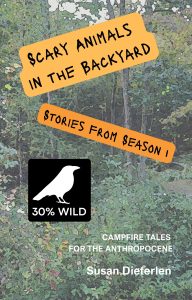
Every coyote, disappearing farmhouse, and Green Man,
Ready for a campfire near you
Plus “No Heroes,” a bonus story only in this e-book
For more facts and figures about bison, see the episode notes for “Eat Burgers, Save the World: Bison.”
Prefer to listen rather than read?