

Nature is our frenemy
We love nature, when it’s butterflies and sunsets, when it’s soothing waves or rain, when we’re hugging a tree. But we hate or fear nature, too, when it’s wildfires, hurricanes, or simply a swarm of mosquitoes.
This isn’t new. You can look back in history, at art and culture, and see this duality of the human view of nature play out over centuries.
It’s the lost Eden – AND ALSO the deep dark forest. In wildness is the preservation of the world, but we’re also dependent on and proud of our creature comforts in the great Indoors.
We’ve “tamed the wilderness” here in the US – a narrative that’s got plenty of baggage – but we’re also the ones trapped in the office, staring out the window with longing at the blue, blue sky. We’re both Snow White, singing while the birds do her housework, and Little Red Riding Hood, hunted by the Big Bad Wolf in the deep dark forest, or Hansel and Gretel, nearly killed – and eaten! – by a witch who lives where?
In a cottage in the forest.
Or, in this case, we’re Goldilocks, choosing among three – or five – bears. Because bears exemplify our “frenemy” view of Nature.
Culturally, we love bears. Toys, the three bears, bear cams, Fat Bear week. But bears are also most certainly a Scary Animal in the Backyard. If you’re afraid of a noise in the dark outside your window, if your thoughts go to animals, “bear” is a big one. Novice hikers are pretty much uniformly afraid of bears, as are most experienced hikers, even in places where there are no bears. Bears are both the cuddly toy that was your childhood companion AND the savage killer that stalks our nightmares. If that isn’t “Nature the frenemy” in a nutshell, I don’t know what is.
Black bears are back all over
But back to that notion of “places where there are no bears:”
How Sure Are You?
Because bears are on the move here in the eastern US!
Note: The US has three species of bears, and they are quite different.
Black bears – smallest, least aggressive – not “not aggressive” – and most common by far in the mainland US. Despite the name, can be brown, blue-gray, blond, or even white. Nearly all black bears in the Eastern US are black, though, a jet black that catches your eye. They are a big black shape lurking, or lumbering, through the woods.
Grizzly bears, aka brown bears. A totally different bear, bigger and badder. Grizzlies don’t live in the eastern half of the US – at press, anyway – and are far less common in the Lower 48 even where they do live. Grizzlies are far more dangerous to humans, but more about that in a moment. Also, grizzlies aren’t always brown. Can be blond, various shades of brown, reddish, or yes, black. When is a black bear not a black bear?
Polar bears, which only live in Alaska in terms of the US, and good thing, because they are pretty scary, although also somewhat adorable. Grizzlies and polar bears are related and can even interbreed with each other, although it’s very unusual. The scariest bear, in my opinion. Also the poster child for climate change ca 2006, when we used to think of climate change as something that would only threaten the faraway polar ice caps and not spawn weather disasters breathing down our necks right here in our backyards.
Black bears will be the ones talked about most here, because they are in the most territory in the lower 48, and the only bear in the wild in the eastern half of the US, which is where our focus is here on “30% Wild.”
Black bears keep showing up in new places. There’s at least a few black bears in every state but Hawaii! Prior to European contact they likely lived all over, again, except Hawaii. Many experts see tree canopy as critical to black bear habitat – no trees, no bears. Also more trees, more bears.
So: deep breath: Your state probably has at least a few black bears, out there.
Somewhere.
“New Places” also means in cities and suburbs and most certainly backyards, meaning “black bears closer to *us*.” Black bears are creeping ever closer to NYC. Upstate New York has plenty of bears, enough to hunt, including in the Catskills. Metro DC has had plenty of media about black bears in the last few years, probably mostly in suburbs.
Like many other scary animals in this season, bears are big animals and can roam a long way. So they can pop up a long way from known bear country. Including in your home or business, particularly in Connectict! The Nutmeg State has seen numerous bears enter houses through screens, through doors left unlocked, and through open garage doors. Which brings me to…
Bear attacks
If you met the three American bears in a bar and picked a fight with each one, maybe insulted its mother or its taste in shoes, hands down, black bears are the least dangerous.
Since the American Revolution ended, black bears have killed about one person in North America every four years, on average. Grizzly bears have killed about one person in North American every three years, on average, despite there being ten times the number of black bears on the continent than there are grizzlies today. And that’s lowballing it, because some experts estimate there could be 300k more black bears than that. In short: there’s a whole lot more black bears.
That third bear in the bar, the polar bear, is usually depicted as our most dangerous bear, the one most likely to be deliberately hunting you versus just being startled by you or irritated by you. Polar bears have killed one person every seven or eight years on average in the entire world – or the entire Arctic, more accurately – since 1870. But there’s only about half the number of polar bears around these days than there are grizzlies.
Perspective: in 2022 alone, over 42 thousand people were killed in car crashes in the US. So the scariest animal in your backyard is arguably your car.
BUT: never sleep on this: the only bear that’s dangerous to you *personally* is the bear you encounter. Since bears don’t actually hang out in bars, you’ll only run into the bears that live where you do and that frequent the places you go. And that, for most of us in the US, is the black bear, and it’s not close.
This is always true about hazards and your risk from them. Like how your chances of being struck by lightning depend entirely on whether you are huddled in your basement during a storm or standing outside on an open hill holding a golf club in the air, or perhaps doing a live video for social media.
There’s *our* risk, overall by the numbers, and then there’s *your* risk, as an individual. You have all kinds of agency over your own risk through the choices you make and the information you learn and remember. Sometimes that doesn’t matter and the lightning hits you anyway, but often it’s the only thing that does matter.
The Complete Collection from Season 1
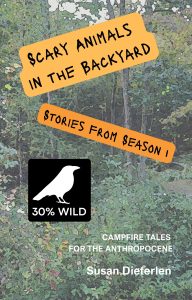
Every coyote, disappearing farmhouse, and Green Man,
Ready for a campfire near you
Plus “No Heroes,” a bonus story only in this e-book
Fear of Bears
Our specific fears about bears are a telling grab bag of fact, fiction, paranoia, and probably some insights into our collective psyche. Everybody knows that you’re safe from bears in the winter, because bears are all asleep, dreaming of eating campers, no doubt. Everybody also knows that the deadliest animal in nature is a mother bear, and that you risk your life going into bear country during a certain time of the month. Right? Or maybe anyone at any time is a fool to go into the woods at all without bear spray.
Are these realistic fears? Are they the lightning strike while you are huddled in your basement or the one when you are standing on the hill holding a metal pole?
Or put another way, are they are bloodthirsty fourth bear or the cuddly third bear in “The Five Bears?
We’re here again, at the end of this post, with only one question that matters:
Which bear is it?
For more facts and figures about bears, possibly in your backyard, see “Bear-anoia.”
Prefer to listen rather than read?