

Have you ever something unsettling happen in the woods that you couldn’t explain?
Well – have you?
If I ask you this question, how would you answer, and what question are you answering?
Most of my guests have understood it as being about the test of real situations in the field against your understanding of science and the natural world. Where are the limits of your knowledge, and how do you handle situations beyond that? It’s especially revealing when you ask people who are experts in one facet or another of the natural world, meaning what we find out there in the woods, or fields, or waters.
But the “unsettling” question is open-ended. It’s open to interpretation, which is what makes it a good interview question. You could understand it as being about mysterious experiences, and the line between the ordinary and myth. As in: “what was that?” and “did you see that, too?”
Either way, it’s about how to understand what we see out there. The challenge is to pay attention to what’s going on around you, in places you don’t control, and to be honest about what you do and don’t understand. This idea was one of the original seeds of this season of 30% Wild, on Scary Animals in the Backyard: what about “Impossible” creatures, those that people see where they really *can’t* be, or those that most of us agree don’t *really* exist anywhere at all – except in stories? I’ve long wondered: when someone sees an Impossible Scary Animal, what is it they really see or experience?
Perception vs Reality
There’s perception, and there’s reality. What we experience vs what’s really there. These two things aren’t the same, and it’s vital to understand that.
It’s true in all kinds of situations where we’re interacting with what’s around us, outside of us. Wind chill vs the temperature on the thermometer: that’s your perception – that’s it’s way colder than it sounds – compared to the degrees in Fahrenheit or Celsius on that objective instrument that can’t feel how hard the wind is blowing.
We see all kinds of things that aren’t really there, but we also *don’t* see things that are there, right in front of us. Like the famous gorilla video with the people passing the ball back and forth, or those keys you can’t find when you are late for work. It’s not about credibility or honesty, at least not all the time. It’s about this gap, between what we perceive with our senses and how our minds interpret that and weave it into an understanding of what’s in front of us, and what we remember of all that. Versus what is actually happening in front of us, independent how we see or hear or think about it, or even whether we notice it at all.
Eyewitnesses to crimes are notoriously unreliable, in contrast to maybe every courtroom drama ever made. Even when the witness is sincere, well-intentioned, and convinced they are telling the truth. Most convictions that are overturned with DNA evidence were originally made based on eyewitness testimony. Seeing a crime and recalling an accurate memory that reflects what you really saw are two totally different things, especially memories made under stress or traumatic circumstances, which is often the case while witnessing a crime, strangely enough.
Here we aren’t talking about crimes, but what animals people see and don’t see. People have reported seeing Bigfoot in every state except Hawaii – because Bigfoot is not a surfer, apparently. It’s easy to find someone to tell you Bigfoot doesn’t exist anywhere, that it’s just a story, and every one of those reports is wrong or lying or at best misunderstood. On the other hand, feral hogs are widespread in the US – officially in 31 states as of 2023 – but people *don’t* see them much, especially people who aren’t looking for them to hunt them or study them. Pigs are big animals and they make a really big mess, but yet, we can live right there among them and never even know.
How?
Or take fishers. If you don’t know, fishers are a kind of giant weasel or land-based otter. And you might well not know about them, because most people have never heard of them, especially outside of New England. Fishers don’t just live there, though – they are reasonably widespread across the Midwest and Northeastern US, as well as the Mountain West. But people don’t even know about them, forget seeing them.
Why?
Just because you saw it, doesn’t mean it was there.
Just because you didn’t see it, doesn’t mean it didn’t happen.
The Complete Collection from Season 1
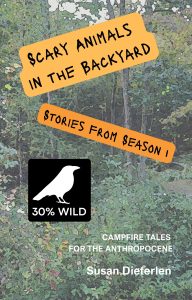
Every coyote, disappearing farmhouse, and Green Man,
Ready for a campfire near you
Plus “No Heroes,” a bonus story only in this e-book
For more facts and figures and links about the impossible things we do and don’t see, see “Impossible Scary Animals: Seeing What’s Not There.”
Prefer to listen rather than read?