

What if campfire stories were about rewilding?
Stay with me here:
The ghost of your yard is a forest. Or a prairie, or even a wetland.
Maybe it’s your neighborhood or your whole town, but in any case, what’s haunting your house is this past: what grew on the ground under your feet, long before you moved in.
Like any good ghost story, this one’s about what happened – long ago, on this very spot! – and how it’s not quite gone today. The past of your yard is so close, lurking just out of sight, that all it takes to rise from the dead is for you to get distracted. Like, for example, by a spooky story or a scary movie. The past of your land, the land where you live, will rise up, a wispy vapor of ectoplasm, thirsting for vengeance and retribution!
Not really.
But – ignore land long enough and it becomes like that abandoned rest area along the highway: a place where nature has taken over. Where nature has taken the Land Back.
Nature rising like the undead and reclaiming land is what we call, in calmer, less “late night at the drive-in” tones, “rewilding.” Sometimes we make this happen deliberately, looking in a mirror in a candle-lit room, and saying “rewilding” three times.
[Disclaimer: actual rewilding process may vary. Obviously.]
Rewilding by neglect
Sometimes rewilding happens in places we abandon, the boarded-up house on the edge of town with those mysterious lights flickering behind the broken windows, only the landscape version. Places like the yard of that house, or the farmland around that house, or the old mine site down the road, where no one ever goes. Probably because of that accident, that horrific accident fifty years ago tonight!!
Not really,
but also sometimes:
Some places really do rewild because we are afraid of them, because of history, contamination, or very real present threats. Chernobyl and the Korean DMZ are the classic examples. But there’s examples closer to home, too. EERILY close to home!
Seriously, though: when we stop doing all the work we do
to keep land pretty and tidy and keep the buildings and roads
we build on it in good repair, because we are afraid of that place or more likely, because we don’t want to pay for it or we simply don’t care about it …”things fall apart.”
What they fall apart into is often a kind of rewilding. I’m really into this kind of rewilding, the behind-your-back, out of sight nature that creeps up behind your back – like that Hookman sneaking up behind you right now! I’m so into that accidental rewilding that I wrote a book about it, called “Design by Deficit: Neglect and the Accidental City.”
Nature comes back changed
Design by Deficit doesn’t really turn the clock back, though,
and give you the pre-settlement past, that forest that was on your doorstep in 1491. Like in every campfire story ever told about summoning spirits from the beyond, the long-gone forest doesn’t come back just like it was. It comes back…different.
You get, not a ghostly prom queen with eyes as deep as the grave, but rather a resurrected nature that’s a mix of survivors, invasives + natives. When you take your hands off the wheel, you stop being able to choose. So you may get all Tree of Heaven, spotted lanternflies, kudzu, and feral pigs, vs a return to pre-settlement Eden. You don’t get 1491. “Before People” is much, much, much farther back in North America, anyway, because it’s before Native Americans arrived.
Nature does take back over, but it’s like the conflict between the coyote (native plants) and the Green Man (invasives) in “Hitchhikers,” the tribute to urban myths that opens the “30% Wild” podcast episode, “Back from the Dead, aka Rewilding.”
Rewilding is usually talked about at more of a major zombie-plague scale, like New England/the Northeast US/the Appalachians
or southeastern Europe, rather than the scale of a lone (spooky) patch on a (dark deserted) highway or behind a (long abandoned) house. But the idea’s the same, whether it’s a whole region or a single flower bed by your front door.
Spooky, but beneficial
Resurrected nature is good for us, too, even if it’s sometimes a little spooky or attractive to coyotes or other hitchhikers. The big message from the beyond on this Ouija board is: we humans need nature to survive, if only for our own survival.
Lots more about this on our website, but the highlights are:
Nature keeps us healthy, even if we live in the city or deepest suburbia or endless farm fields:
Cleaner air and water
Keeps climate cooler – fights extreme weather
Counteracts the impacts of stress on our bodies, fighting all kinds of chronic diseases and ailments caused by or made worse by stress. Things like cardiovascular disorders and high blood pressure.
Speeds our healing
Nature around us give us a Mental health boost, maybe the antidote we need in the terrifying 21st century. That mental health boost could be just what’s needed to stop that crazy ax-wielding maniac heading for your back door! Or at least to make our lives a bit less plagued with depression and anxiety, some modern-day plagues that can make you FEEL like a zombie.
More natural land helps keep the Pollinators around that we need for food production – a real-life scary situation. It also helps keep our birds around to control insects – and stop some non-zombie real-life plagues.
We can get all of that, just by letting land get a little more wild. Even better, by letting a LOT of land get a LOT wild. Or a lot of little pieces of land all over get re-wild. Tiny wildnesses, all over. A lot more woods to get lost in, shooting that shaky found footage. You might run into a bloodthirsty cackling witch
or a headless Hessian or even the Big Bad Wolf.
But you WON’T find a future without birds or pollinators or winters. It’s a potent tool to keep those scary stories around the campfire and out of the actual news headlines.
The Complete Collection from Season 1
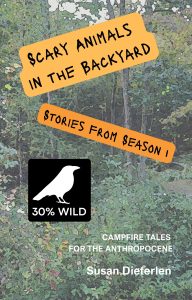
Every coyote, disappearing farmhouse, and Green Man,
Ready for a campfire near you
Plus “No Heroes,” a bonus story only in this e-book
For more facts and figures about rewilding in your backyard and elsewhere, see “Back from the Dead, aka Rewilding.”
Prefer to listen rather than read?