

How many sightings of Impossible Scary Animals are exactly this: seeing an animal or a human-like shape in a totally unrelated object?
We Want to Believe
Do we simply want to believe? That there’s more out there, that the wilderness is still untamed and closer than we think, that we know better than science and data and all kinds of modern digital apparatus. That there’s still a role for intuition and eyewitness. That there’s a realm beyond this one, life after death or alternate realities or the land of Faerie or whatever. That important essential truths remain hidden. That an ordinary person in the right place at the right time can show up all the experts.
Maybe we want our senses to back up what we’ve already decided to believe, a little something we call “confirmation bias” – that we tend to decide new information is credible if it works with what we already understand and believe, not so much whether it honestly seems believable or real.
It’s work to change our minds, and we’ve gotten a long way as a species by not doing that work when we don’t need to. If you know there are tigers in the brush, and you see something that might be a tiger, you don’t hang around and weigh whether it’s objectively likely to be a tiger. You just get out of there, and therefore you don’t get eaten by a tiger. If you were wrong and there was no tiger, there’s no penalty, comparatively speaking. You live to overreact another day, maybe even teaching your offspring to overreact to imaginary tigers, and so it goes…
Humans believe in things. People. Institutions. Stories, too. These days, there’s a lot of things that quite a few of us have stopped believing in. Maybe we’re hungry for something else to believe in. Especially if there’s other people who believe it, too, and we can be one of them, among the believers. Not out in the cold, alone.
Heuristic toward faces
Do you see faces when you’re alone? Not in your imagination, but in inanimate objects. Like wood grain, or patterned flooring, or potato chips?
If you do, you’re not crazy, or at least no crazier than me. I could tell you yet where each face was in the wood planks on the ceiling of the living room in the house where I grew up, and for a bonus point, where an animal or two were in the stones on the fireplace.
I lived this as a child, but I learned its name much later, in grad school. This tendency, seeing faces in objects that aren’t alive, is a type of heuristic, a mental shortcut we take to make decisions quickly – like, “is that a dire wolf?” – and let our brains focus on other things – like, “run from the dire wolf!!”
This particular heuristic is called pareidolia. In addition to faces, you might see human forms like figures or arms, or animals. There’s also an audio version, where we hear whispers or laughter in sounds that aren’t alive, like the cliche “babbling brook.” Or possibly when there’s some kind of thump or clatter in your house and you mistake it for a family member’s voice.
Psychologists, who are the experts here, think we do this because it served our ancestors well over millennia to see other humans, enemies, or predators immediately, maybe before it was really clear that was what was really there. It let them respond to potential threats to themselves or others quickly, even if it meant they overreacted at times.
There’s not much penalty for overreacting to false alarms, in terms of survival in primitive life among very big, very scary animals who want to eat you. In modern life, we very much are penalized for being wired to overreact to false alarms in terms of anxiety and chronic stress.
Other psychologists think that our tendency to see faces stems from how we as infants respond to faces, which helps foster attachment with those caring for us. This worked very well for our ancestors and probably us, too, in that it helped motivate the adults around us to cherish us and take care of us.
To an infant, everything is new and mysterious, a world of chaos. Perhaps recognition of a face in that wires us mentally to see or seek faces in other places. Kind of leftover from infancy, your original baby brain still ticking away inside your head.
At minimum, psychologists see that our brains look for meaning wherever they can. Simply put, that’s the job of our brains: to make sense of the world around us. Sometimes they get creative in that task.
The shrinks emphasize that if you see faces and animals and whatnot in objects around you, it’s nothing to be alarmed about. It’s a kind of creativity, seeing the world in different ways. Like seeing figures in the clouds.
All of this makes me wonder:
How many sightings of Impossible Scary Animals are exactly this: seeing an animal or a human-like shape in a totally unrelated object.
Our brains doing what they do. Making our surroundings more interesting, even if it freaks us out from time to time with one of those false alarms.
So maybe it was just a tree stump.
But maybe it wasn’t.
The Complete Collection from Season 1
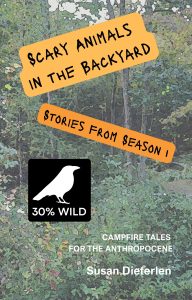
Every coyote, disappearing farmhouse, and Green Man,
Ready for a campfire near you
Plus “No Heroes,” a bonus story only in this e-book
For more facts and figures and links about the impossible things we do and don’t see, see “Impossible Scary Animals: Seeing What’s Not There.”
Prefer to listen rather than read?